learning from the man crèche

image

Waiting for a train, reading a notice board on the platform. It’s a real curiosity generator.

It seems, just within a mile or two of this platform, I can join a talk on the Inter City story hosted by the local Railway Correspondence and Travel Society. Who knew such things existed, or that experts travelled to tell the story of the creation of this brand?

I can donate £5 to buy a brick to help extend the local primary school – perhaps a reflection of the slow decay of government as the inexorable demands for funding grow in all quarters and increasingly cannot be met?

I can get my bike serviced with options ranging from a ‘tune up’, through a ‘full monty’, to a ‘strip and rebuild’ – there was a time a full monty might have been all in, but now a strip costs more.

I can join a debate on Georgian Kitchens and Cookery, hosted by the Local History Society – is that a debating topic? I’m not sure I’d have much to argue?

But the notice that most intrigues me is the Man Crèche.

The term crèche might normally be equated with children and I love this notion that one exists for fully grown men. The poster asks, “Is he getting under your feet?” It goes on to suggest, “Leave him with us. We’ll look after him.” Apparently, “All he needs is his pocket money.”  There are poker nights, curry nights and, most intriguingly, a pie night which incorporates a gravy boat challenge. I’m hooked by the gravy boat challenge. Games for men. Opportunities for men to play with men. How fabulous.

Ideas that shake up norms. That challenge our thinking, question convention. These are useful. They generate new possibilities, new thinking, new learning for us.

Taking a word like crèche and juxtaposing it with another people group. Juxtapolicious!


the joy exposed through presence

image

We’ve been for a walk this morning. Through woodland, around lakes, past meadows.

Nature is glorious.

A little red backed beetle scuttling across the path in front of us, speeding on his way at a pace seemingly unfit for stoney terrain and his diminutive proportion. A swan family with six brand new cygnets wafting gently across the water, staying close, staying safe. A robin resting on a gate post, observing our approach with head cocked, inquisitive and remarkably trusting. A heron majestically soaring above a copse, with just the odd beat of its wings, on the search for an impromptu meal. Cowslip reaching up through long grass and nettles to peek at the sun. A long since fallen tree, performing a new role in its deadened state, home to moss, fungus, a myriad of insect life. Water on a lake, gently gliding left to right, the merest ripple inspired by an unfelt breeze. A lively chiwawa, out for a stroll with its owner, racing ahead, standing proud and telling us what’s what, with a big dog syndrome beyond its stature. Little fluorescent blue dragon flies flitting in staccato jerks beside our path. An unseen fish, stealing a morsel from the watery surface, leaving an expanding story of ripples. A coot, nesting beneath a swooping bough, preening and tidying, busy and private.

Being present in our world is such a privilege.

contrary to contradiction…

image

The well bred contradict other people. The wise contradict themselves.

Oscar Wilde

I don’t claim to be wise, but it amuses me when I contradict myself.

For example, I sometimes catch myself behaving in a way which flies in the face of what I’ve just said. Or saying something that contradicts what I’m doing.

For example, the other day, to allow a group of people to explore learning, we folded our arms, then unfolded them, to fold them again the other way. We were exploring the process of learning and I asked them to reflect and then share their process of learning. I explained there was no judgement. I then asked them to repeat the folding but said, ‘Now fold your arms the wrong way.’ I noticed my use of ‘wrong’ and smiled inside.

We are funny aren’t we?

We are multiple. More than one. Made up of parts. Light and shade. Simple complexity. Surface depth.

for fear of repeating myself…

groundhogday

“I might have told you this before…”

I say that quite often.  Or something similar.  Usually I’m about to tell a story.  A story that makes a point, or enhances a previously made point. Or maybe it’s a story to support or refute the point you just made.

I know the story. I’ve said it before. I just can’t recall whether I told you. Or someone else. Or if it’s just a story I tell myself. One of those ‘in head practice’ stories. Or, one of those conversations where only I’m present. Me talking to me.

Usually I go ahead anyway.  Mostly people are polite.  Sometimes they say, “I know, you’ve said before.”

I’ve been on the receiving end too. Someone tells me a story. One they’ve told me before. Maybe twice before. Or five times. They tell it with gusto. Like it’s new. Sometimes the context is different. Mostly it’s not.

It’s as if we like our stories. Like a good book, we’re happy to read them several times. The story is what matters. The person we’re telling, not so much. The context and relevance, not so much. If those things mattered equally, we might remember. But no. The story comes out again. The story is what matters. It’s as if actually we’re telling ourselves. We telling and listening. The other person is incidental in this transaction.

What about our life story? Is that a story we tell ourselves? Over and over? Is that a story we share with others? Over and over?

Is that a good book?


trapped in a void, with a pending yogurt imperative

image

Our office has access control. We carry cards which we touch against pads to open doors from corridors, stairwells and lifts. Public areas in effect. Mostly we carry these cards on lanyards around our necks.

This morning I was in early to do a ‘breakfast briefing’ – you know, describing what a sausage is. 😄 Language makes me laugh sometimes. Anyhow, I digress.

My porridge instruction was to be on one floor, my office on another. I carried some materials, a cup of tea and various facilitation aids up to the room my croissant warming was to take place in.  I left everything on a table and set off back to the office to print something.

On the stairs, a realisation dawned. My lanyard and access card were on the table. I was trapped in the stairwell. A humanless void between the areas of work. I was alone. Caught in the connecting arteries of office life.

I knocked on a door and peered helplessly through the narrow glass slit on one side. It was early though. Few people were around. My tapping went unanswered. Suddenly I heard the ping of the lift arriving two floors up. In sad desperation I bounded up the stairs hoping to meet someone I could beg to grant me escape from the void. I arrived just in time to hear the click of the door, closing, as they had already entered the human space, leaving me in the soulless vacuum. I trudged back down to my tapping door.

I smiled at my ridiculous situation and my preposterous attempts to escape the void. Why is there nobody around to save me? How will my willing breakfast briefers ever discover good yogurt to fruit compote ratios?

The lift on a floor above pinged again.  I turned and took several steps before ruling out another fruitless jaunt upstairs. Peering through my tapping door once more I finally saw my rescuer. An internal passer-by responded and freed me from my humanless void.

Nobody starved. Breakfast briefing was restored.

My moments alone though, trapped in contactless oblivion were curious. My panic, my irrational behaviour, my helplessness, my sense of isolation.


defending our position against the odds

kite

Yesterday evening two red kites were circling a neighbour’s garden.  They are impressive birds when they drop from their lofty soaring heights. Strong, powerful, intimidating.

We watched, curious about their intent. It seemed they had located potential prey.

A squawking alerted us to the arrival of a crow.  It flew straight at one of the kites, colliding with it in mid air. The crow, although itself large, was dwarfed by the kite.

Bravely, the crow defended its position. The kite retreated. Its pair soared high on the late evening thermals.

Like the crow, when we have something to defend which matters to us, we too can be brave beyond reason. Sometimes though we can be foolhardy. Holding on and defending a view to the point that it becomes a weakness and we expose a vulnerability.

Maybe soaring above our behaviour to get perspective is the wise thing?


time to turn around?

image

There’s a lane near us that often closes due to flooding.  It’s a nuisance, but when it’s shut we have to drive around to get to our destination.  There are several alternatives, but each is a longer route.

We just do it though. We don’t go back home and say, “Oh well, no going to the shops today.” Nor do we drive down the lane and stop at the point where the water has risen to a foot deep, park up, and say, “We’ll wait for the floodwater to subside.”

We don’t even think about it. We turn around and try a different route.

Today in a meeting, we got stuck. We set out to achieve something as a group and every suggestion fell on stoney ground, or everything we tried seemed to move us no closer to our objective. Yet we persevered. The mood in the room became flat. Frustration emerged. Disagreements rose up like unwanted nettles in the garden. It took us nearly an hour for someone to ask, “Why are we finding this so difficult?” This gave someone else the opportunity to say, “Let’s try something different.” So we did. Completely different. And we made progress.

Strange that when our route is blocked physically, we instinctively and immediately detour. Yet when our thinking is blocked, we bash on, stubbornly persisting with our thinking. Getting further stuck as emotions then bind us up like creepers around our feet.

Turn around. Go another way.


when we are played with by our own emotions

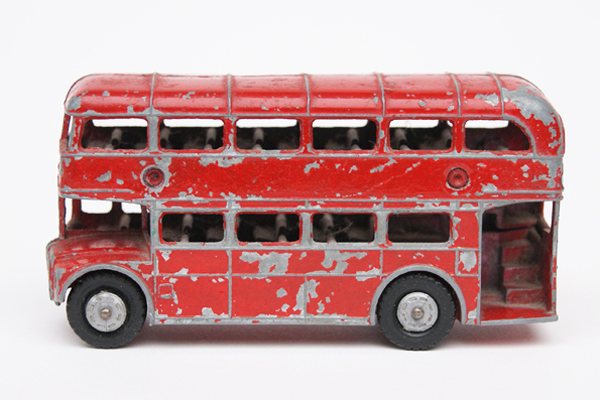
Earlier this week I hopped on a bus in London.

As I found my seat, the bus pulled away and I noticed a taxi slowing next to the bus, as the gap ahead was too narrow.  He slotted in behind, but merely for a few moments, before accelerating alongside the bus.

There was an exchange of views through open windows. Thankfully mostly inaudible, but clearly both had a perspective on what had just occurred.  They drove together sharing their perspectives for a few moments before the taxi veered off.

The bus driver audibly muttered ‘stupid’, thumped his wheel twice and clearly, as he repeated the word at least five times over the next three or four minutes, his attention was directed inwardly to whatever emotions he was feeling after the exchange.  Certainly some anger, maybe some frustration, possibly some hurt?  Who knows?  Maybe not even the driver.

I reflected for a moment on the safety of his passengers, as evidently his mind was not fully on the busy London traffic.

There is a drought of compassion in our world, and a deluge of blame.

I wished for my bus driver to be able to step outside his emotion and notice what was happening for him.

His emotions and doubtless those of his fellow combatant, the taxi driver, trapped them in their blaming world.

Stepping into what he was feeling, and why, might allow him space to contemplate what the taxi driver might also be feeling; from that awareness comes the capacity for compassion, for self and for others.

Sometimes we are merely toys, played with by our own humanity.