leaking power through thought

habits of thought leaking power
I wrote yesterday about giving our power away.

We do this in our patterns of thought too. Our habits of mind can cause our power to leak away. Dissipate. Below is only a partial list of ways you might do this. Study the list. Notice your habits.

Do you spend time, in your head, beating yourself up?
Do you have regular thoughts about being better than…?
Or about not being as good as…?
Do you judge yourself and come up short?
Do you focus on pleasing others?
Do you catastrophise and fear the worst before it’s happened?
Do you regret old failures or lost opportunities?
Do you replay old hurts or difficult conversations in your head?
Is it a pattern of thought to be bitter about circumstance and to think about how unfair things are?
Do you over focus on enemies or on revenge?
Are your thoughts directed to taking control?

Or maybe you have another pattern of thought?

Your life energy is a resource – you can use it wisely or squander it just like any other resource. Make an estimate of how much of your thought you spend on habitual thinking which gives away your power. Then address it.
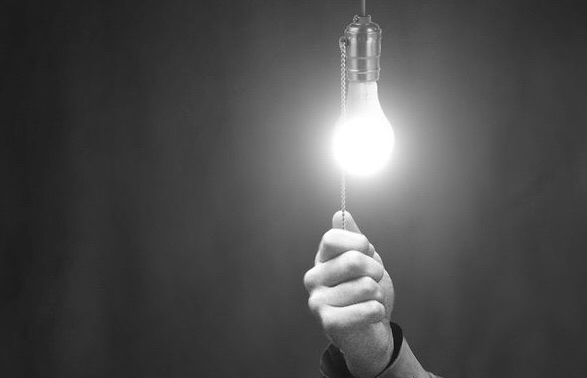
when the power is lost, the lights go out

giving power away
A colleague at work has been leading a new project. She has surveyed the territory, read the research, summarised the viewpoints and gathered the core material. It’s time to document our stance and intended direction.

She invited others to share this work, valuing a collective approach. Now a couple of drafts have been produced, attributed to their shared work, but my colleague is disappointed. Disappointed in herself.

I discussed it with her. The work has lost the essence and the inspiration she found through the research, but also, it no longer reflects her.

We explored how she has given her power away.

We can all do this.

We give our power away when we doubt ourselves. When we try to make everyone happy or look for others approval and validation, thereby over-empowering them.
We give our power away when we fail to honour or share our personal truth. We do it when we compare ourselves to others or worry what other people will think. We do it when we forget that we know what we’re doing and that we are good at it. We do it when we have poor boundaries and allow others emotional activity to intimidate us and leak into our world. We do it when we lose sight of what we need or want, instead placing focus on what we see externally in the world as the blocker – lack of money, time, ability, looks, weight…

But giving your power away diminishes you, disables you, casts your personal light in shadow.

a word from the led

leadership a word from the led

And in the end we follow them –
not because we are paid,
not because we might see some advantage,
not because of the things they have accomplished,
not even because of the dreams they dream
but simply because of who they are:
the man, the woman, the leader, the boss,
standing up there when the wave hits the rock,
passing out faith and confidence like life jackets,
knowing the currents, holding the doubts,
imagining the delights and terrors of every landfall;
captain, pirate, confidant and parent by turns,
the bearer of our countless hopes and expectations.
We give them our trust. We give them our effort.
What we ask in return is that they stay true.

The Contract – A word from the led by William Ayot

so, how do I change that?

service change
If my car stops working, I take it to a dealer or garage and say please fix this. Generally that works. In part, that’s because the car is one of many identical models. It has a specification. The mechanics are trained and no doubt have detailed on line manuals describing how every part works as well as knowledge of the steps required to breathe life back into those parts that don’t.

We all possess many ‘things’.  If they stop functioning to our needs we fix them, or we replace them.

We are so used to this, we somehow seek to apply the same laws of our materialistic consumerist world to our very humanity.

But here’s the thing…
Human beings are inordinately more complicated and each one is stunningly and beautifully unique. No manual. No like for like replacements.

To hope that all of your learning, life experience and behavioural pattern making since birth, can somehow be re-modelled in a few simple steps … a bit like reprogramming the central heating timer … is curious.

And yet we do.

I often get asked in coaching sessions a question a bit like this one … “So how do I change that?”

It’s almost as if we believe we’ve just missed out on a chapter in the ‘How to be a happy human being’ book. Or perhaps misinterpreted some instruction along the living highway which explained how we were supposed to be. Or maybe that we think someone else messed it up for us, so now we have become aware we can just change course, tweak something, switch out one part for a new one. Whatever our thinking about how we came to be like this, we seem to think this ‘expert’ in front of us, this ‘human mechanic’, can somehow put us right.

Changing ourselves is hard work. Rewarding, but always hard work.

And as we set out on that journey, we would do well to remember that we are unique. To value that uniqueness. To seek to enhance and grow what is, not discard it as broken or not good enough.

the emergence of the selfie

looking at self
What gets a lexicographer up in the morning? Where does the energy come from?

Maybe the advent of new words? Maybe the evolution of old ones?

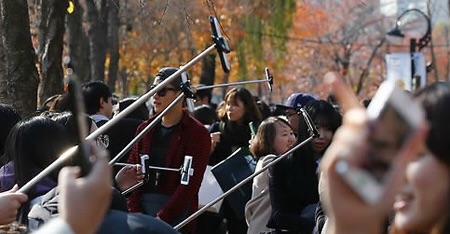
Selfie is a new word. This sudden penchant for capturing ourselves against our current environment. Looking at ourselves in our context. Getting an arms length perspective. Using a selfie stick to get even greater perspective. To see from further out. To fit more of our situation in.

Our desire to share these 2D representations of self in these static snapshots of life, is curious. We seem strangely reluctant to show ourselves in living 3D, in reality, as we exist in the world with other human beings. Alive. Both beautiful and beautifully flawed.

Of course we have always had the ability to look at ourselves from the outside. Inside our head. Long before technology gave us the ability to record an image, many of us did that in our mind’s eye. Imagined it. We see ourselves in that awkward conversation. See ourselves in that meeting where we were criticised. See ourselves in that beautiful moment of joy, of fun, of love.

Our mind’s eye has an important advantage over the selfie. We are not limited to the current moment. Not limited to a selfie snap and a hard drive of past experiences captured in still reflection. Inside, we can do this imaging, this ‘selfie’, for our future too. Imagine our own future. Our upcoming holiday. Our new home to be. We can manipulate the image – past or present. Make it brighter, more colourful, turn it around, zoom in or out. Take parts out, add parts in.

Take a mental selfie now of where you will be next week, next month, next year.

Perspective and context are crucial to our humanity. They allow us to see possibility, to reflect, to dream, to make sense, to know we’re ok.

Click.

Remember too though that living, sharing, enjoying reality in the moment are more deeply human. Share the gift of you, now, in glorious living technicolour. Not just in smiling, staged, two dimension tomorrow.

Don’t just take a selfie. Be one.

Lexicographers – let’s add ‘be a selfie’

hello, hello, can you hear me?

now communication
“Hello, hello. Can you hear me?” the man says.

He removes the mobile telephone from his ear and looks wistfully at its display. Shrugs, and places it alongside the other phone and his tablet, laid expectantly on the train table in front of him.

Three communication devices and ironically he can’t.

Of course when that happens to us, we play that guessing game. Should I call them back, or wait a few moments in case they’re already dialling?

The desire to connect immediately is new to humanity.

I’ve never had a postal service representative knock on my door and say, ‘sorry, a colleague just tried to deliver your letter to Grace in Hull and she’s out.’ Nor do I feel the need to follow up my letter to Grace with another, sent next post, saying, ‘did you get my previous letter?’

We never needed phrases such as ‘offline’ or ‘out of office’ when communication simply involved speaking, reading or writing. People were either there in front of you, or they were left to choose when to digest your message. Without pressure. In their own time. No expectation.

A book doesn’t have sentences at the foot of the page such as ‘any questions so far?’ or ‘don’t turn the page if you haven’t followed the plot to date.’ Nor does it urge us to read the entire novel in one go.

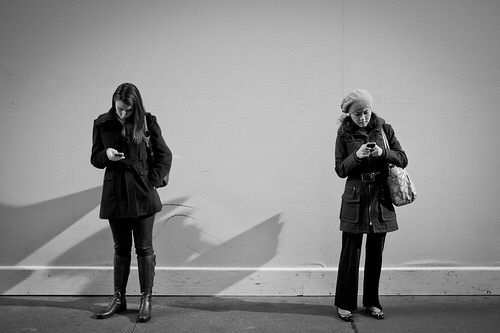
Yet I’ve heard people say they struggle with Twitter because they don’t have enough time to read everything. Hours are spent thumbing the Facebook feed on our touch screen ever upwards, pausing briefly to look at Erin’s new pony, or read Graham’s latest holiday itinerary, or watch the video clip that one second earlier you didn’t even know existed, let alone that you needed to watch it, now.

Hello, I’m here now, tell me everything now. Don’t let me miss out on anything now.

The man opposite waits. Surely someone wants him?

how does your inner self see you?

self image
I’ve just followed a chap wearing a trilby and a waistcoat.

In my head, that would be me.

I’m not a sweater man.

I would have a funky moustache with those little waxed twirled ends. A cool haircut, as befits the younger me (I’m not sure I know what a cool haircut is, but I’d have one). Maybe some sunglasses, but only in the summer.

My clothes would be strong colours. No patterns. Just blocks of orange, yellow, green, cyan etc. No red, it’s not me.

Stylish shoes. Expensive. Well made.

I’m an individual.

I have a few of these things in my current ‘me’, but I wonder why not more? Why is my inner sense of me and my image different from that I show outwardly? I suspect it’s about judgement. Judgement of myself.

I wonder what it would be like to lose that judgement and to let the real me out?

What does your inner sense of you look like?

What would it be like to let it free?

the move for movement

movement change reflection now
Water seldom stands still.

Part of the endless water cycle. Rain, snow, hail and other precipitation falls. It runs from mountain to valley, it seeps into the ground, it pours into rivers. Driven by gravity, it is drawn down towards the earth. Providing a life source for plants, humans and other species. Then, from the land, the oceans and seas, evaporation and condensation draw the water up again, high into the atmosphere where the cycle begins again.

Water in many forms, with many uses. Always moving, always transforming, always serving.

As human beings we too seem drawn to movement. To move away from a past or present truth or to move towards a future one. Drawn too to transformation. Drawn to experiment. To change our state. To experience change. To work towards something. To grow our usefulness. To breathe life into something, someone. To find a new place. To simply find a place.

The inevitability of movement.

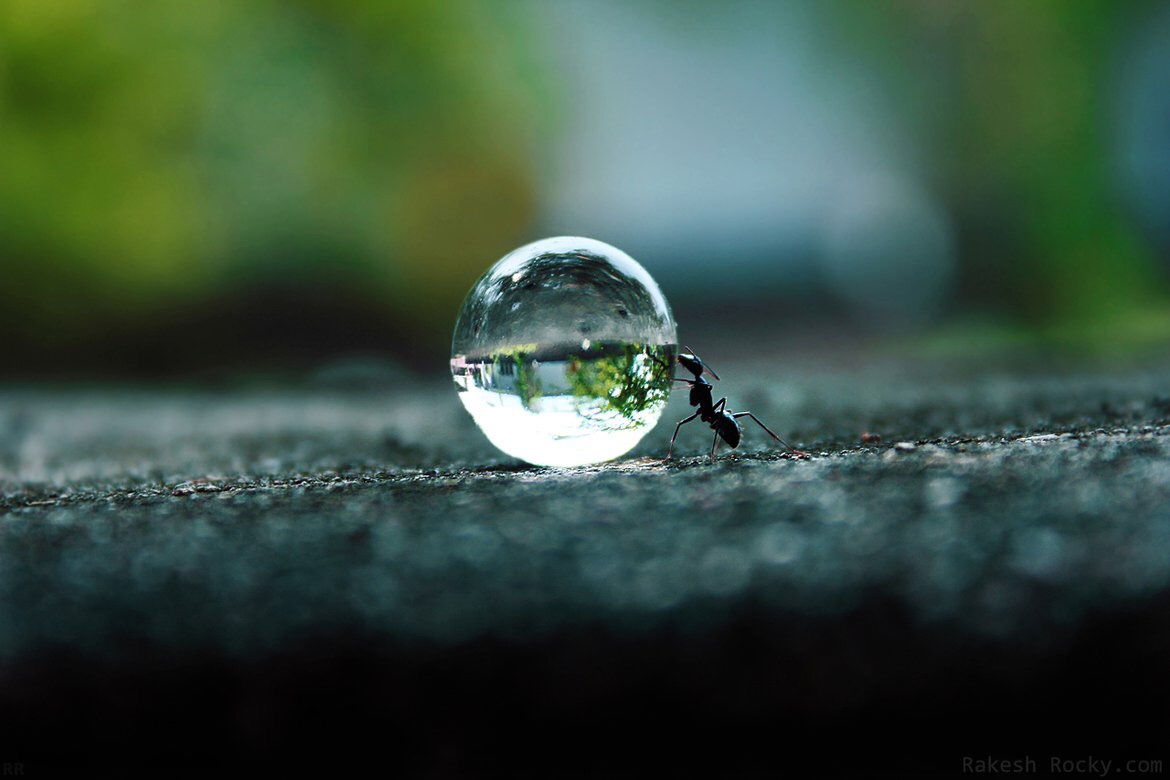
Yet water pauses too. Beads of water hesitate in the arms of the leaf, pause as a dew droplet on a blade of grass, hang in the air in a foggy breath, rest for a moment in the rock pool. Socialise with friends in the puddle, the lake.

Water reflects the beauty of now. The glassy eye of the water bead displaying its surroundings in a full panorama. The puddle reflecting passers by, life in action.

As human beings we would do well to mimic this behaviour too. To pause in the moment of now. Life comes in these moments of rest, these moments of reflection, these moments of connection with each other and the world we live in. For in one sense this is our purpose.

The cycle of movement will continue, relentlessly. It will happen whether we seek it or not. Just like the water cycle, it will complete. But like the water droplet, we would do well to pause, to reflect the light around us. Ours and that of others.