are you busy? too busy to read this?

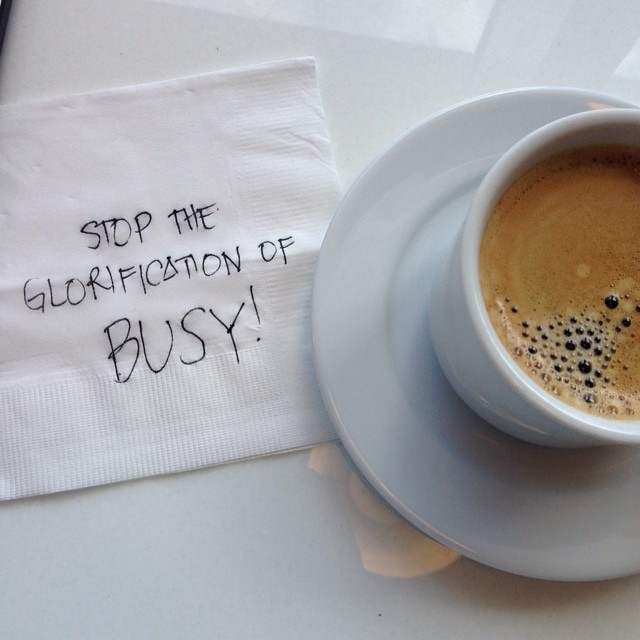
stop the glorification of busy
Are you busy? Too busy to read this? If so, maybe you should read it…

In recent months I have noticed the conversation starter at the coffee machine at work follows a familiar path, when you meet someone you haven’t seen in a while, whoever it may be. Maybe you recognise it? Or maybe you instigate it?

It goes something like this …
“Hi long time no see. What are you busy working on at the moment?”
or
“How are you?” Back comes the reply, “Really busy. You?”
or
“Hello, not seen you in a while.” “No things have been really busy…”

If you’re really busy you might want to stop reading this now.

If you live to an average life expectancy you have a total of around 620,000 hours. Given that we sleep for around a third of that, you have about 410,000 usable hours.

Time is a strange concept though isn’t it? I mean, what is an hour?

I often have the following debate with my wife when the clocks change – she’ll say something like “We gain an hour this week-end” and I’ll respond, “No we don’t, it’s just that what we call it has changed. Six o’clock is now known as five o’clock.” The Earth, Moon and Sun still move in the same harmonious rhythm. We still have the same amount of time in our lives. What we call the time is just that, it’s what we call it.

And we can call ourselves busy. Too busy to spend a few minutes on someone or something that is really important to us.

What matters most is how you use your time; those precious hours that are in short supply.

When was the last time you simply did something you love?
The last time you were kind to yourself?
The last time you carried out a random act of kindness?
The last time you stopped and really noticed another human being?
The last time you checked in with yourself, properly?
The last time you gave someone the gift of your full attention?

Next time you meet someone at the coffee machine, if the conversation starts down the ‘busy’ route, ask them a great coaching question and really listen to their response.
Maybe something like …
“… and how would you like it to be?”
or
“… and if you weren’t busy, what would you be?”

or maybe just invite them to contemplate what they would be doing right now if they were doing something they love.

And now you’ve read this … go and take five minutes for yourself.

if you could shop for emotions, what would you get more of?

emotions shopping
I need to shop for food today. Saturday isn’t a normal shopping day for us – too many people in the aisles. The aimless people. I’m a list shopper. Odd really as I never make lists for anything else. The list has to be in the right order for the route I will march purposefully along with my trolley. It provides a structure. I’ll deviate from it, of course… the list. I like deviating from a plan. In fact I don’t plan normally either – too much structure.

Anyhow, it occurred to me, what if I could shop for emotions? What would be on my list? What do I want more of and what do I have enough of in the cupboard?

Do I want more joy? More caring? More trust? More serenity? Do I need a little more sadness? A big pot of empathy? Do I need to refill my anger? Maybe I would like to take some lonely back to the shop?

Am I baking a relationship cake and need some extra courage? Some more selfishness, a little daring, some strong, rather than medium fun, a big box of compassion, a soupcon of adventurousness and a large tin of hurt?

Maybe I’m about to change role and I need to stock up on thrilled, thoughtful and excited, buy a refill pack of embarrassed, but also purchase some ashamed and not good enough seasoning?

Or maybe I’m being forced to change role and need some hope, a little vindictiveness and a splash of inadequate to go with the large supply I have at home of feeling used?

What would be on your emotions shopping list?

learn to unlearn you must

yoda unlearn
Your brain is a meaning making machine. The greatest meaning making machine we know.

It works through patterns. Once learned, those patterns repeat, time and again. Once meaning is learned, it is adhered to relentlessly.

Most of this is out of consciousness. Some estimates suggest that the unconscious mind is as much as 95% of brain activity. Trigger … response, carried out automatically without what you might consider as ‘thinking’.

The challenge is that most of these patterns are shaped in childhood. Experiences early in our lives create emotions and child-like cause and effect reasoning; meaning making which creates our sense of self, our rules of the world, our beliefs about our place in the world and how to belong in it, all at a time when we are very unworldly.  A necessary process for the very survival of our ancestors – the ability to learn quickly and create strategies, crucial.

This process continues today though, and patterns and strategies learned in childhood repeat, over and over, as we progress into adulthood. Often the patterns no longer have relevance in an adult world, or the meaning has changed, or maybe was simply misinterpreted originally by the seven year old?

Running on automatic with patterns, strategies and meaning which disable rather than empower, limit rather than enable, constrain rather than offer choice, is at the heart of our struggle to reach our potential. These are limiting beliefs.

So, unlearning patterns of thinking, patterns of feeling, patterns of doing could be the most important learning you will ever do.

The first step is to become conscious of the pattern. Then explore its origins – where did it start, what’s your earliest memory of believing that? Is that belief or strategy relevant now? Does it serve you? What are you distorting in that memory? What has been deleted? Where is today’s evidence and what gets generalised in your thinking?

Start now, be curious, what needs to be unlearned?

what is your baseline state, where you live your life?

state
What is your baseline state? Where do you live most of the time?

Do you live in a state of worry, or a state of restlessness, or a state of trying (to be better, good enough…)? Do you know your baseline state?

You’re probably aware when your state changes. We change state all the time. You’ve probably experienced a state change when you’re hungry or tired – it may be harder to concentrate, perhaps you’re a little irritable? Our state impacts our behaviour, our ability and also our choices.

Changing state is unique to our individual humanness. Take moving from asleep to awake. When I awake, it’s like a gradual wave of consciousness. Often my mind becomes active almost immediately, but my body, particularly my eyes often need longer – fifteen to twenty minutes sometimes. It’s as if in that initial awake state I am focused internally and not yet ready to engage with the world. For others, waking is like a switch – mind, body, emotions ready to go, almost instantly. Be curious about your version of a state.

A state involves thoughts, feeling and physiology – bodily clues exist as well as emotional and mental ones. Posture may change. There may be a rise in heart rate, shallower breathing, churning stomach or hunched shoulders.

States are often associated with our environment, what’s going on around us and what we feel, think and do in response. We’ve all experienced a euphoria or joy when something good happens, or a sudden moment of panic when something scary or bad occurs.

States, thinking, physiology, feelings are all interconnected. Each impacting on each other. Like a five-a-side football team these four play in formation with environment. One moves, makes a run in one direction, the others move in response. Constant momentum, like a roller coaster loop – twisting, rising, falling without end.

We attempt to control this wild ride, primarily through thinking. Yet four other parts are on the ride too.

Change your environment, your state changes, your feelings shift, your thinking alters. We’ve all walked in the fresh air to clear our heads. Experiment. Sometimes your environment or physiology are easier to alter. Do you run, so that your head clears, so that the endless thoughts subside? This is changing your state.

In this way, our state isn’t just the result of our thinking or emotions. It can also change them.

So, what’s your baseline state? The state you are in when the other four players aren’t moving position on the pitch? If your baseline state is anxious, or striving, or hurried, or confused, or afraid, or something else that isn’t working for you, change it.

Live your life in a state that works for you. That way when you’re blown off course, you know where you want to get back to.


are you scared?

scared change
Are you scared?

Sometimes I am.

The world is changing at an unbelievable pace.

Did you know that there are now more people in the world with access to a mobile phone than access to a toilet?

That would have been inconceivable only a decade ago. If change happens that fast, what will be true in ten years time?

And will you cope?

The world is changing. Business is changing. Communication is changing. Your job is changing. Are you changing?

The irony is that at this time of unprecedented change, what we most need … is an ability to change.

To change ourselves.

Not to become someone else, but to adapt, to be more agile, to learn quickly and change our approach, change our behaviour, change our thinking, change our response, change our direction.

Put simply we have two choices. We can shoot the change. Complain. Try and stop it. Avoid or hide from it. Run away. Deny it.

Or … we can stop looking outside and look inside. At ourselves.

It starts with giving ourselves attention, building our capability to understand ourselves; this enables choice, agility, resilience, freedom, learning, growth, happiness.

Maybe in ten years time, more human beings will have full access to themselves than currently have access to a parking space?

How cool would that be?

the true meaning of coffee …

beliefs change
Many years ago I trained as a master practitioner in Neuro Linguistic Programming. I trained with a friend.

The training was near Hammersmith in London and at the beginning of each day we would go for a cappuccino and a bacon sandwich at a little Turkish coffee shop nearby. Although the training modules were several months apart, on seeing us enter at the beginning of a new module the owner would always recall our order – one sandwich on white, one brown, one without butter etc.

That coffee shop has sadly gone now, but that experience still anchors me to that time of learning, and I doubt the owner and his cheery waitress have any knowledge of how much that stays in my memory.

It serves to remind me that interactions between human beings can sometimes have more importance than their seemingly ‘low level’ content might suggest; they can carry more meaning than those involved at the time might ever realise; the spoken word or behaviour may have a completely different result or impact to that intended at the time – indeed one NLP presupposition is that the meaning of the communication is the result it elicits, not necessarily the one the giver intended.

Every day, all day, we give out communication, consciously and unconsciously. Everyone we meet takes their own meaning from that, even if several people experience the same ‘message’, each will create their own meaning.

In our early years, much of this gives rise to our beliefs about the world. Some of that serves us well in later life. Some does not.

The parent with the adolescent child, studying for their exams, will doubtless have the best intention to support them. Comments such as ‘never mind, you did your best’ or ‘all you can do is try’, have positive intentions. Yet I have seen such people in the middle of their lives, still running a belief that ‘I’m not good enough’ or ‘I have to work hard’ or even a more complex belief such as ‘If I don’t succeed nobody will love me’.

Spoiler alert: you probably believed in Father Christmas when you were small. Your parents span the yarn. It served you to believe – you got toys, chocolate, the excitement of presents to unwrap, and as a child that’s desirable. My guess is most of you no longer believe in Father Christmas.

The meaning we take at one point in our lives doesn’t have to be the meaning we live with. Trying hard when you’re 15 might be useful – please a parent, pass an exam. Trying hard later in life, when your work life balance is out of kilter, or when you’re in a job you loathe, or when you’re burning out through effort, or when you just want your boss to notice you, isn’t necessarily so helpful.

The barista can make many coffees.

You have a choice whether yours will always be the same.

if you think you think, think again…

Chocolate behaviour

We are at the top of the food chain. Our ability to think, to cognitively assess, decide and act is unparalleled.

Or is it?

Yesterday afternoon I ate a large chocolate bar.
I wasn’t hungry. I know it’s not good for my waistline. Only the other day I was reading about the hidden threat of too much sugar in our diet. I had a banana on my desk, which, despite its curvaceous yellow appeal, remained ignored.

Human behavior is complex and rarely, if ever, purely rational. In fact our rational internal dialogue almost always loses out to a deeper, hidden, irrational, impulsive, unconscious drive to act.

But, behavior doesn’t happen by chance or out of the blue. It has a structure – trigger, behaviour, reward. In one real sense we are machines: input, action, output. Mechanistic rather than thinking.

Behaviour can be conscious or subconscious, mental or physical, learned or inherited, voluntary or involuntary… some behaviour is genetically and biologically underpinned – we all withdraw our hand from the hot saucepan handle, from pain, without thinking. Some behaviour is influenced by social and cultural norms. Some by persuasion or even coercion.

That doesn’t however explain my chocolate addiction.
Nor does it explain much of our behaviour day to day.

I’m not genetically coded, socially expected or forced to curse that driver sat in the middle lane of the motorway. Nor to stop working on what I should be doing to do something more interesting. Nor to be late for that meeting. Nor to run for the bus. Nor to buy those trousers I don’t need.

No, these behaviours are motivated internally, by our beliefs, values and biases. By hidden patterns developed and evolved by our life story.

I regularly curse middle lane drivers. I’ve examined this behaviour closely. It’s not that I’m a stickler for the Highway Code – I confess I don’t always follow it. It’s not that I’m in the habit of moaning at people. It’s not that I’m often late and they’re simply in my way. For me, it’s because they aren’t honouring, recognising, making space for a fellow human being. They’re self absorbed. That value drives other behaviours in me; some I’m not proud of and that just happen before I can rationally think. So the unfortunate motorist is merely the trigger. My reward is I can honour a personal value – yet the irony of my own behaviour contradicting that very value is not lost on me and therein lies another behaviour puzzle. What remains true is that in that moment, the behaviour is unthinking, subconscious, mechanistic, programmed … out of my control.

Or is it?

You see, consciously understanding my internal motivation, beliefs, values and world map gives me choice. Noticing the triggers and the rewards of my behaviour gives me choice. So be curious about you.

If you think you think, think again…


have you noticed who has control?

eye_earth


I am me.

In all the world, there is no one else exactly like me.
Everything that comes out of me is authentically mine, because I alone chose it – I own everything about me: my body, my feelings, my mouth, my voice, all my actions, whether they be to others or to myself. I own my fantasies, my dreams, my hopes, my fears. I own my triumphs and successes, all my failures and mistakes.

Because I own all of me, I can become intimately acquainted with me. By so doing, I can love me and be friendly with all my parts. I know there are aspects about myself that puzzle me, and other aspects that I do not know – but as long as I am friendly and loving to myself, I can courageously and hopefully look for solutions to the puzzles and ways to find out more about me.

However I look and sound, whatever I say and do, and whatever I think and feel at a given moment in time is authentically me. If later some parts of how I looked, sounded, thought, and felt turn out to be unfitting, I can discard that which is unfitting, keep the rest, and invent something new for that which I discarded.

I can see, hear, feel, think, say, and do.
I have the tools to survive, to be close to others, to be productive, and to make sense and order out of the world of people and things outside of me.
I own me, and therefore, I can engineer me.
I am me, and I am Okay.

A declaration of self esteem
Virginia Satir

how are you spending your life … literally

spending time
If you were given £750,000 the day you were born, and knew that was all you would ever get, how would your choices be different?

At home the other week, we were discussing changing our carpets upstairs. I’m sure you have such conversations in your lives too … can we afford to replace the car, should we re-do the bathrooms, where shall we go on holiday this year, can I afford that training course I’d love to do?

Often a factor in such conversations is money and a choice about what we can afford. We play one thing off against another. Money is a currency we understand.  It gives us choices, informs our priorities.  We strive to acquire more, so that we can have more choice.  But what if there was a finite sum?

Time is a currency too.

The offer of £750,000 reflected the fact that most of us, living a full life into our mid 80s, will have around 750,000 hours on this planet. You can’t buy or earn any more.

Yet time, we fritter away with less conscious attention than a handful of small change.

We allow others to spend it for us.  Especially in work.  I’m required to be in that meeting. I need to travel to Glasgow. I have to finish that report this week-end. I must spend a few hours this evening getting on top of my email…

Even worse, we do this with our energy.

Our lives become dominated by things that not only eat into our time on this earth, but also which drain us of our energy.

That dull meeting you wish you weren’t in. The hours commuting. The dinner party with the couple you don’t really like. The hours in the gym you hate, but tell yourself you ought to do. The tedious job you wish was different.

Meanwhile, the simple things in life that energise us, we find less time for. Reading a book. Playing with the children. Enjoying an amazing view. That hour of yoga. Baking some bread.

You have around 750,000 hours in your life. It’s your choice how you spend it. Spend more of it on the things that inspire you and less on the things that are other people’s choices or that allow your energy, your very life essence, to leak away.

photo credit: BramstonePhotography via photopin cc