human detox anyone?

image

Sitting in Vera’s Kitchen for a cuppa. A fine cafe in Letchworth.

The menu begins with ‘detoxing soup’.

Is that possible? Can soup have a detox effect? What toxin exactly is being removed from your body by consumption of said broth?

Detox, detoxifying, detoxing are ‘a la mode’ at the moment it seems.

But when do we detox our humanity? Remove the toxic parts of our being; the flotsam picked up along our life journey?

The unwanted thoughts. The unhelpful behaviours. The disabling feelings. When do we recover from the self toxifying life journey that has left us with redundant beliefs, self doubt, insecurity, poor self image, vulnerability, limiting thoughts, low self esteem?

That’s the soup we really need.


giving it out and bringing it back

rapport

We all get on with some people more than others. Sometimes we just click immediately. Sometimes the connection develops over a period of time. But what is rapport?

But when we have a rapportful relationship we know it. We are drawn to it.  We enjoy experiencing it.

Its origins as a word seem to be French – rapporter – to bring back, or return, and a definition might be…

a state of harmonious relationship in which the people or groups concerned understand each other’s feelings or ideas and communicate well

So maybe rapport is simply about giving and receiving? Giving some of ourselves; our ideas, thoughts, emotions and being open to others’ ideas thoughts and emotions in return. Where these connect or overlap, we have rapport.

Sounds easy.

Of course we have to know enough about ourselves, and be open-hearted and generous enough, to be able to authentically share what our feelings, thoughts and ideas are . And we have to be present enough and care enough to hear what is reciprocated.

Maybe that’s why it isn’t always so easy?


reading between the lines

image

I followed a van the other day.

Its brightly decorated paintwork advertised service, repair and maintenance. I gazed absent mindedly at the contact details. A number and a website.

A Quaking.

Service and repair after an earthquake? Wow, that’s a niche market.

I looked again… and moved the space. Aquaking. “Aqua King” not “A Quaking”.

Misunderstanding and misinterpretation. Sometimes the signs are hard to read. As they can be in life. Our own signs in particular. Learning to read yourself is perhaps the best skill you can acquire. Understand and interpret wisely, for misunderstanding and misinterpreting your own thoughts, feelings and behaviours could cause significant tremors.


emotional culture

happiness

Many organisations pay attention to cognitive culture rather than emotional culture.

They attend to the known things such as values, goals, objectives, rules and policies. They measure employee achievement in terms of these and they pay attention to employee behaviour in this context; are you doing what is required and are you doing it the right way?

What and how. It’s what many appraisal systems focus on too.

Does your workplace measure the emotional culture though? Do they check in with you on how you’re feeling about work, today, this week, this month? Are people having fun, enjoying their work? Are you happy, sad, demotivated, excited, anxious, enthralled? Does your boss know?

In reality your emotional state is likely to have more impact on your behaviour that a set of cognitive ‘these are the behaviours we expect’. It is also likely to impact your productivity, your performance, your levels of engagement with your work, your sense of wellbeing – physical, mental, emotional, social and spiritual – and therefore minimise your days off sick.

How we feel about our work feeds our sense of belonging and our sense of purpose. If we enjoy our work, we get a degree of excitement from doing it, a sense of improvement, achievement and personal growth.

How happy were you at work today?

happiness


buildings wear hats now

image

There are many new buildings being erected nearby.  It’s interesting to see the construction and in particular one common feature I have noticed. They all have an ‘add on’ on the roof, to house, I presume, the heating and ventilation equipment.

I guess many years ago, such ‘hats’ on our buildings weren’t required?

It’s possible to see the pipe work and cabling in the guts of the building, criss crossing the currently naked ceilings. An infrastructure to support the future comforts, efficiency and effectiveness of the eventual inhabitants. Of course once they take up their positions, this wiring and plumbing will remain invisible and only the fruits of its work will be in evidence to the people interacting and achieving inside this house of work.

Many of the things which enable us to work as individual human beings are equally set up thus.

Much, created as we were being built. Now invisible. Sometimes keeping us comfortable and enabling us to be at our best. Sometimes having the reverse effect, limiting us and making us in some way uncomfortable.

We don’t have the luxury of simply removing the ceiling tiles and being able to maintain or improve this infrastructure. Well, not easily. In truth much remains hidden to us.

Maybe time to check under your hat?


the present lie about absenteeism

daydreaming
Most of us work through the day.  We sit in our office or car. We stand on the production line. We pore over our computer. We meet others and decide important things. To do this, we are expected to be present. To be wherever our work requires us to be.

But physical presence is a lie, a misnomer, if we think it signifies presence in our work. Occupation, activity, productivity, output, quality.

I can sit and stare at words on my screen and yet be somewhere completely different, in my head. I can be in a meeting and look to be taking active part, whilst emotionally being totally disconnected. I can even be driving my car and be on auto-pilot, because my attention is on some unrelated, yet important, mental distraction.

This is largely invisible to those around us. A secret we keep.

We all do it. We do it all the time.

Physically present. Mentally and emotionally elsewhere.

Why is it that the ponderings, thoughts, feelings, of another place, another time, another scenario, with other people, are more important to our bodies, than where our bodies are?

Wherever you are now.  Where are you?


get out of my shoes now


image

Empathy is the new black.

Schools are teaching empathy to children. Leaders are encouraged to display EQ as much as IQ. Many books explore building empathy. It’s a core coaching skill. Developmental psychiatrists and psychologists are exploring the roots of empathy in animals and the deep nature of its place in our humanity. True empathy is good. Deeply human.

To be clear empathy, as opposed to sympathy, could be described as feeling with someone, rather than feeling for someone. “I feel your anguish” as opposed to “I am sorry you’re hurting”.

It is standing in their shoes to experience their emotions.

But empathy requires thoughts as well as feelings. It is also a two person activity. So to be truly empathetic we need to balance thought and emotion as well as balance self and other. Recognising and sharing in someone else’s complex emotional state is in itself a complex inner experience, and it requires considerable self awareness and control to walk that line, be useful, be safe, keep them safe.

Otherwise empathy becomes a trap.

We can feel we are being held hostage by the other person’s feelings. Imprisoned in our own thought / feeling response. Balance requires us to have the self awareness and the dexterity and subtlety to pay attention to another’s needs whilst not sacrificing our own needs. We need to be able to recognise what is our stuff and what belongs to the person we are empathising with. Also what emerges in the soup of the empathetic interaction. What needs to stay in the soup, neither theirs nor ours.

Putting ourselves in someone else’s shoes is something the receiver can find deeply rewarding. Addictive even. That puts the onus on us to know when to extract ourselves from their shoes. And how.

Equally, overly empathic people may lose the ability to know what they want or need. They may have a diminished ability to make decisions in their own best interest, experience physical and psychological exhaustion from deflecting their own feelings.

We need to be able to stand in our own shoes too.


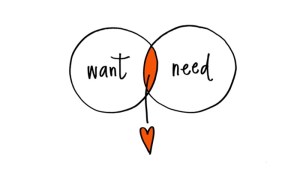
needs and wants, wants and needs

want need
Waiting in for a plumber. I’m not good at waiting for someone. Deliveries, tradesmen etc. My choice is removed. I’m in their control.

I want to get out.

I need to wait though. We may have a leak. A telltale little brown patch has appeared on a ceiling.

I should wait. The leak could get worse. Despite this more sensible course of action, I’m still drawn to go out. Nowhere special, just to have the freedom to decide. It’s the freedom I want. The expert opinion I probably need.

The tension between what we want and what we need is intriguing. Are needs more powerful than wants? Are needs more fundamental to our sense of self and our wellbeing? Certainly needing shelter, water, food would seem to be basic needs. Yet wanting something can be a pretty strong draw too. Wanting to move, wanting freedom, growth, learning, progression, choice. These too are powerful motivators.

Refugees and economic migrants pouring into Europe seem to demonstrate the power of wanting a better life for your family. Wanting opportunity. Wanting freedom. Or is the migration need driven? The need for safety, for security?

I wonder if our modern world has confused the two? Do I need a new phone, or do I simply want one? Do I want a hug, or are there times I absolutely need one?

Do we know the difference any more? The difference between a need and a want? How the difference motivates our thinking? Which has more feeling? Which trumps the other? Which do we value more? The things we want and have, or the things we need and have?

Are the words interchangeable, or is it some other orientation in our lives that motivates us to prefer one word over the other? Do independent people have a penchant for wanting things? Is wanting essentially selfish? Wanting something certainly implies choice, preference. Needing something suggests less choice. It suggests necessity.

But is it the same for us all? Is there a common thread to our humanity? Or is this a more personal matter?

Maybe you want to know? Or need to? Maybe you don’t? Understanding that which motivates us would seem to be useful though? How your choice of language impacts your thinking, your emotions, your behaviours?

where are the confused people?

confused angry emotion
You know that exercise we do after conferences or meetings, where before we check out the facilitator says, “Let’s do a temperature check”. “Let’s go around the room. Everyone sum up how they are feeling in one word”.

They’re asking because we’ve just been told something and we might be having an emotional reaction to it.

How many synonyms are there for thoughtful?
Reflective, pensive, contemplative, pondering …

How many synonyms are there for open minded?
Curious, wondering, intrigued, anticipating …

These are neutral. We can’t be challenged on them. They’re to be expected almost. We’ve just been told some new information, something is changing, why wouldn’t we be thinking about this new information and why wouldn’t we be open to what we’re being told is to be the new reality anyway?

I wonder though…

Where are the confused people?
Where are the angry people?
Where are the scared people?
Where are the resentful people?
Where are the lost people?

Our language for emotions in organisations is woefully lacking and our ability to connect with and honour our personal truth, in such a public forum, is so hard to reach.

Pain is a feeling. Yet feelings can be painful.

pain and hurt
I’m in pain.

A sleepless night. A trapped nerve in my shoulder.

It’s hard to concentrate and hard not to. I can’t think and I can’t sleep. The pain is my focus.

Physical pain can do that. But so can emotional pain.

Feelings can dominate your very being. Consume you. Just as much as physical hurt.

I have painkillers now for my shoulder. They should soon help the physical pain. Chemicals in tablet form that I acquired from the local pharmacy. Even though I’m in a fairly remote location, I can get help with physical pain.

Emotional pain is harder to treat.

Yet just as debilitating.
Maybe more so.
Harder to get help.
Harder to cure.