hello, hello, can you hear me?

now communication
“Hello, hello. Can you hear me?” the man says.

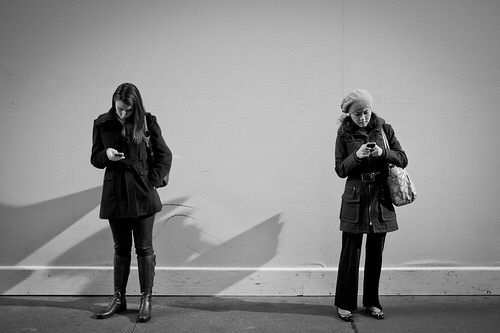
He removes the mobile telephone from his ear and looks wistfully at its display. Shrugs, and places it alongside the other phone and his tablet, laid expectantly on the train table in front of him.

Three communication devices and ironically he can’t.

Of course when that happens to us, we play that guessing game. Should I call them back, or wait a few moments in case they’re already dialling?

The desire to connect immediately is new to humanity.

I’ve never had a postal service representative knock on my door and say, ‘sorry, a colleague just tried to deliver your letter to Grace in Hull and she’s out.’ Nor do I feel the need to follow up my letter to Grace with another, sent next post, saying, ‘did you get my previous letter?’

We never needed phrases such as ‘offline’ or ‘out of office’ when communication simply involved speaking, reading or writing. People were either there in front of you, or they were left to choose when to digest your message. Without pressure. In their own time. No expectation.

A book doesn’t have sentences at the foot of the page such as ‘any questions so far?’ or ‘don’t turn the page if you haven’t followed the plot to date.’ Nor does it urge us to read the entire novel in one go.

Yet I’ve heard people say they struggle with Twitter because they don’t have enough time to read everything. Hours are spent thumbing the Facebook feed on our touch screen ever upwards, pausing briefly to look at Erin’s new pony, or read Graham’s latest holiday itinerary, or watch the video clip that one second earlier you didn’t even know existed, let alone that you needed to watch it, now.

Hello, I’m here now, tell me everything now. Don’t let me miss out on anything now.

The man opposite waits. Surely someone wants him?

important safety information

safety
Monday morning and the train journey.

I find myself gazing at a notice. Important safety information.

The notice tells me ‘These instructions are provided for your safety in the event of an emergency’. It continues by reassuring me that if there is no immediate danger, I should await instructions from onboard staff.

Where are my safety instructions for life? For living?

When I feel unsafe, there is no handy information guide. When I feel uncertain, no useful diagrams and pictures. No advice on what to do. No step by step instruction. When I feel threatened, no arrows to show me escape routes. When I need help, no emergency equipment provided and no colour coded symbols to help me decide.

And at times of emergency, my onboard staff tend to have done a runner. I’m not thinking clearly. Not resourced to help myself.

Often in life there is more risk, more fear, more danger from our way of being, our patterns of thought, our interactions with self, than from the trains we travel on. Maybe we need to pay as much attention to the important safety information for our humanity?

our stories of self

once upon a time
We have a story for ourselves.  Sometimes more than one. Sometimes the story we tell, is not the story we live in.

This was beautifully expressed to me recently when a coach colleague shared this experience

A coach I met recently shared a fascinating story with me about a client they were working with and some profound learning they had experienced.

By their third session, the coach noticed how hard they were finding it to connect with the client and find the truth in the stories the client was sharing. They had a growing sense that the client was not being authentic. The coach noticed how this was affecting their own flow in the sessions.

After this third session, the coach spent much time reflecting on why they felt so uneasy about the situation and admitted to themselves that something just wasn’t right.  Maybe they just weren’t good enough as a coach to support this client?

The coach decided to share their unease with their client at the next session. Whilst waiting for the client to arrive, the coach convinced themselves that the client might be better off with a more experienced coach as the coach clearly had now developed some bias that would get in the way.

The coach gently approached the subject with the client and said “I’m truly sorry, but I have to admit I am struggling to connect with you and more importantly I find myself doubting whether you bring real events in your stories or ones you imagine yourself having”……this last part changed everything !

The client shared how they had imagined when they were younger, that their life would be so very different from what it was now. It transpired the client was mourning the life they had hoped they would have and the person they believed they would become. Their unconscious grief for this representation of self, resulted in the invention of a new reality in which the client remained the same age, the same values and the same personal goals they had had 25 years ago.

This realisation had a profound affect on the coach and resulted in transformation for the client.

This story is both a brilliant reminder of what we do as coaches and at the same time a sobering reminder of the complexity of our humanity.

As coaches our gift to our clients is to support them navigating their personal truth in search of something more whole, more true, more fulfilling – the story is heartwarming in that regard.

Yet the story also serves to show how ‘wierdly’ our very humanness can work for us.

Our brains and bodies can take us on strange journeys, through thought and feeling patterns, to strange places. In this case, for this client, from clarity of vision for self, to grief for an unfulfilled, imagined self, to the creation of a false self, with all its stories, false realities and ties that bind that client to a life less than their potential.

It shows also the power of our stories of self.  The story we imagine for ourselves, the story we exist in, and the story of what we might be.

Stop being who you were or who you could have been… instead, be kind to yourself and be who you are.

if there were human being shops…

change me
Self awareness offers choice.

Once the choice to be different is apparent to me, visible, possible; Once I know what I want, I’m ready to move. Impatient. I can see the sweeties on the shelf and I want them … now!

At moments of deep realisation for my coaching clients, I often get asked in those sessions where the sweeties become apparent, a question a bit like this one … “So how do I change that?”

This question intrigues me.

Of course, it presupposes change is possible and that’s great in a coaching context; we want our clients to come keen to achieve their goals. But the presupposed simplicity implied within the question is another matter.

Often the new awareness pertains to a way of being that we have honed for many years; It is well practiced, in the muscle, part of how we are.  The idea we can shift to a new model, a new way of being through one or two simple steps is fascinating.

We all possess many ‘things’ in this ‘modern’ world. If they stop functioning to our needs we fix them, or replace them. It is as if we somehow seek to apply the laws of our materialistic consumerist ‘thing’ world to our very humanity. I’m ready to change me, where do I go, who has the upgrade part?

If my car stops working, I take it to a dealer or garage and say please fix this. Generally that works. In part, that’s because the car is one of many identical models. It has a specification. The mechanics are trained and no doubt have detailed manuals describing how every part works, along with the knowledge and experience required to breathe life back into those parts that don’t.

If I have a two slice toaster and more family members are eating together I can upgrade to a four slice model. No matter how long I have lived with the two slice, my needs have changed, so I can just change that aspect of my life. An hour down the shops, five minutes on line, change made, life easier.

But, here’s the thing…
human beings are inordinately more complicated and each one is stunningly and beautifully unique.

No manuals. No upgrade models down the shops.

To hope that all of your learning, life experience and behavioural pattern making since birth can somehow be re-modelled in a few simple steps … a bit like reprogramming the central heating timer … is curious.

And yet we do. It’s almost as if we believe we’ve just missed out on a chapter in the book ‘How to be a happy human being’. Or perhaps we misinterpreted some instruction along the living highway which explained how we were supposed to be? Or maybe that we think someone else messed it up for us, but now we know that, we can just pull the tiller and steer the right course? Whatever our thinking about how we came to be like this, we seem to think this ‘expert’ in front of us, this ‘human mechanic’, this ‘coach’ can somehow put us right.

Changing ourselves is hard work.  Possible.  The prizes can be enormous. Life changing. But it’s always hard work.