the space to be

fix-what-you-think-fix-what-you-do

The next time you have a thought… let it go

Ron White

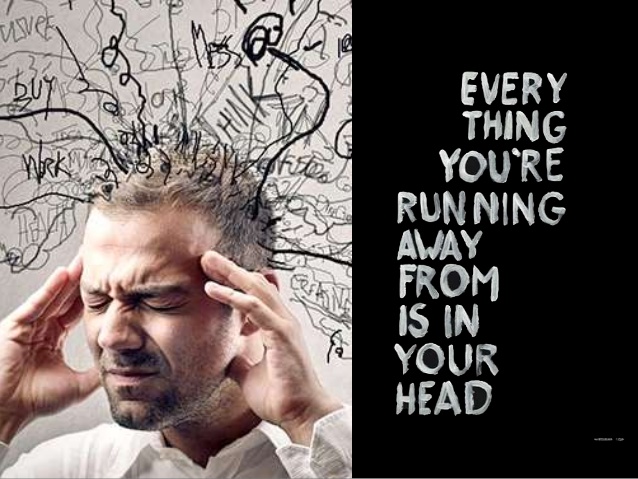
We can become slave to our heads.

We ping pong between the past and the future. What has happened and what might happen. What we need to do. What we did or didn’t do. Experiences we have had. Opportunities to come. Lists of things to do. Things we did, or should have done.

Our thoughts begin to run us.

I must do this…
If only I hadn’t…
What if…?
Don’t forget…
What did I say…?
Should I…?
Why…?
When can I…?

Find instead a place where the mind is quiet. The body is present.

The space to be.

now is the only everlasting memory

image

Many years ago, the photograph was a physical thing.

Nowadays we live in a digital age. The image has become a series of ones and zeros, which can be shared instantly across the globe. It can be enlarged, edited, colours saturated, edges blurred. It can be enhanced with special effects, have its background changed, detail enhanced. All of this can be achieved in seconds. Methods and means for sharing are many, and once a photograph is out in the social network we lose track of its global journey; who might see it, where, how and when.

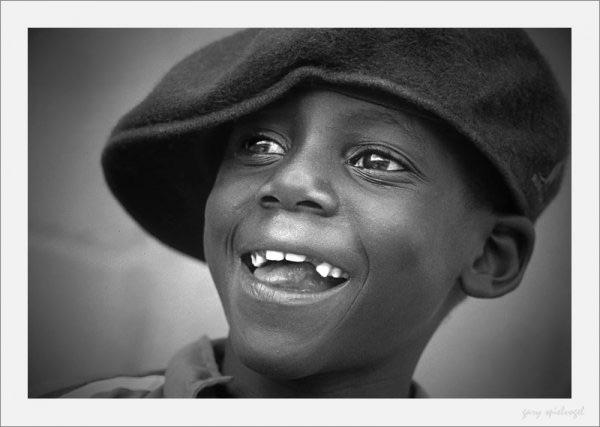
When we capture a smile in a photograph, it has an eternal quality. A moment in time is captured in digital form to be shared and enjoyed for ever. It becomes an everlasting smile. Or does it?

The photograph cannot replicate the human experience. The feeling that went with the smile. The sensation of the facial muscles drawing the lips back. The image or experience behind the camera that generated the smile. The joy of the moment. The supporting emotions of fun, love, togetherness, excitement, happiness. It cannot hold within it the sharing. The memories.

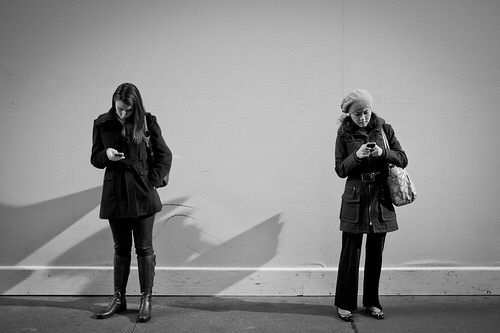
Today we have become obsessed by taking the picture. We snap them constantly. Delete the duplicates. Discard the imperfect. Edit them to impress.

Maybe we have forgotten to enjoy the moment? To take in the experience? To absorb the emotion and allow the feeling to wash over us like a wave of liquid happiness? To live the experience and therefore to enrich the memory? Maybe the smile in the moment is the only truly everlasting smile? The one in the now?

Let’s focus on the moment, not on the creation of the ones and zeros.


does Father Christmas exist?

belief future Christmas
When I was a child I believed in Father Christmas.

In part because my parents told the tale and I believed in them. I trusted them as parents. As adults.

In part also because it served me well. I was rewarded. Brightly wrapped presents, sweets and other childhood delights were bestowed upon my compliance. My letter to Santa, brought me gifts.

In part also because everyone else in my child world believed too. I was fitting in by believing, rather than being outside the group.

*Spoiler alert* I don’t believe in Father Christmas now; although I perpetuated the myth with my own children when they were small.

Our beliefs about the world change over time. So too our beliefs about ourselves.

What I believed about work when I was 12 was quite different to what I believed twenty years later at 32. What I believed about the value of money has shifted again in the last twenty years. Certainly my beliefs about girls were very different at 12 to those I held at 22. My beliefs at 40 about human beings, compassion, possibilities are quite different to those my sixteen year old self held. My beliefs about what is important have shifted too. So too my beliefs about my abilities. And much more.

The point here is that our beliefs change over time.

I wonder how would it be if we set an intent to shift a belief in advance? Rather than it shifting simply through the ageing process and maturity, as a result of situation, life experience, context. What if we decided now, what we wanted to believe in say a decade?

What do I want to believe in ten years about money, about fun, about time, about learning, about being healthy, about happiness, about relaxing, about pleasure, about society, about religions, about conflict, about equality, about difference, about humanity?

Can I in some way change my future if I set out, now, to have a different belief about these things in my own future?

Maybe different gifts are possible? Not those delivered by Father Christmas, but by increasing my awareness of myself and by setting out to believe different things about me and the world I live in… what might be?

Now that, might be worth wrapping with a bow.

time to flex your happy muscle?

happiness mindfulness meditation
For many centuries, great sages, such as Aristotle, Bhudda, Confucius and Epicurus have advocated the pursuit of happiness. They have suggested happiness comes from within, from creating an inner peace, from reflection. Happiness of the mind, rather than of things.

Now science appears to be catching up. I have just been reading about a study at Kyoto University. The research, reported here, has identified a part of the brain, the precuneus, which appears to be larger in people who self declare themselves to have meaning in their lives, who report positive emotional and cognitive experiences and describe themselves as happy. This has been correlated to studies into meditation, which show that the precuneus grows in people who make meditation a part of their lives – it seems that calming our thoughts, being present in the current moment can exercise our happy muscle.

The research speaks of psychological training that could increase the volume of grey matter in the precuneus, which in turn may enhance subjective happiness. The report’s summary says…

Psychological studies have shown that subjective happiness can be measured reliably and consists of emotional and cognitive components. However, the neural substrates of subjective happiness remain unclear. To investigate this issue, we used structural magnetic resonance imaging and questionnaires that assessed subjective happiness, the intensity of positive and negative emotional experiences, and purpose in life. We found a positive relationship between the subjective happiness score and gray matter volume in the right precuneus. Moreover, the same region showed an association with the combined positive and negative emotional intensity and purpose in life scores. Our findings suggest that the precuneus mediates subjective happiness by integrating the emotional and cognitive components of happiness

Time to flex the happy muscle?

Now that’s a happy thought…


trick or treat?

trick or treat memory
Tonight is All Hallows’ Evening, or Halloween.

To most it signifies dressing up, makeup, trick or treat. Probably pumpkins, with cut outs illuminated by candle, casting an eerie visage? Maybe a party, maybe a bonfire and fireworks?

I wonder how many revellers realise that many believe it is a night to remember the dead? Those martyrs, saints and believers who have passed on. Lighting candles is thought to attract their souls.

Of course, as with much that is ritualistic and ancient, there are other theories too. We simply cannot be sure.

We don’t need religious or historic events though to carry with us to the present day a misnomer or false interpretation of reality. Many of us do it with our own memories … and we were actually there when they happened!

Often a childhood memory lives with us. But often it is distorted, mis-remembered. It carries the understanding of the child. Parts of the actual occurrence are deleted, parts twisted to fit our childhood emotional need, parts simply forgotten in the story. Yet we run this edited inaccurate story throughout our adult lives. It holds us, trapped in a mythical past, caught in a story of fiction and we behave today as if it were true. We carry the remnants of the experience in the form of a broken relationship or a belief about ourselves that no longer serves. It was probably never true, but we made it so, and now we have run it as a video, or heard it as a story in our heads, so many times that we hold it to be a reality. It now controls us. Limits us. Makes us smaller.

Maybe we would be well served to honour it as dead? Just like the souls Halloween remembers? Maybe we would be well served to think of it as a myth, a fable, a misinterpreted story of long ago? Maybe we should move on and pay more attention to now?

Treat yourself, don’t trick yourself.

Look after your soul, not that of a long dead memory.

making meaning from now

making meaning from now
The concept of ‘now’ intrigues me.

I have always considered myself someone who is very present, in the moment, in the ‘now’. But reading something in a book by Steve Chapman the other day, gave me a different language to describe it. This is what I took from what I read…

Time as we know it, is a social construction, a human invention, something that over many centuries we have honed and agreed universally as a good way of orienting ourselves to movements of the solar system, and to getting to our next meeting on time!

The most obvious ever-present reminders of the concept of time, are the clock and the calendar.  These have developed over centuries from lunar calendars to solar calendars, sundials etc… to, I guess, the i-watch.

This clock time, or chronos time – the on going perpetual march of seconds, minutes, hours – ticks away on our watches, clocks and electronic systems all over the world.

Daniel Stern argues that if chronos time were real, then the moment of ‘now’ would be so fleeting that we would never be able to dwell on it long enough to make meaning of the experience.  We would in effect be goldfish, with each ‘now’ moment lasting +/- one second; the unit of chronos.

The Greek concept of kairos offers an alternative perspective. Kairos is a moment of indeterminate time in which everything happens. While chronos is quantitative, kairos has a qualitative, permanent nature. In kairos there are no seconds, minutes, hours, just the idea that kairos time is a passing moment of consciousness, in which something happens that offers us new meaning in our experience.

The author of my book summarises the two like this…

chronos time is a concept informed by clocks
kairos time is a concept informed by meaning

What would happen in organisations if we abandoned chronos time and just interacted, communicating, learning, until a new collective meaning emerged?

Meetings wouldn’t have agenda items with start and end points, but each item would be explored until collective new meaning emerged. Some agenda items might take five minutes, some items ten times as long.

Of course for this to work, people need to be open to learning, open to having generative conversations, open to enquiry with others as to where collective meaning existed, or was lacking.  People would need to be very present in this ‘moment of meaning making’. No longer slaves to chronos time, people would interact throughout the day until sufficient meaning had emerged for individuals to move forward, for the business to move forward.

In such a kairos informed culture I wonder if this would make us more curious, more exploratory, more accepting of alternative viewpoints and enable us to both seek meaning in our work and in our lives? It might also free us to play with our creative spirit.

What would happen if we lived our lives to kairos time? Not just at work, but all our experiences?

Even as you read this, you may be seeking to find new meaning for you?

Welcome to kairos 🙂

hello, hello, can you hear me?

now communication
“Hello, hello. Can you hear me?” the man says.

He removes the mobile telephone from his ear and looks wistfully at its display. Shrugs, and places it alongside the other phone and his tablet, laid expectantly on the train table in front of him.

Three communication devices and ironically he can’t.

Of course when that happens to us, we play that guessing game. Should I call them back, or wait a few moments in case they’re already dialling?

The desire to connect immediately is new to humanity.

I’ve never had a postal service representative knock on my door and say, ‘sorry, a colleague just tried to deliver your letter to Grace in Hull and she’s out.’ Nor do I feel the need to follow up my letter to Grace with another, sent next post, saying, ‘did you get my previous letter?’

We never needed phrases such as ‘offline’ or ‘out of office’ when communication simply involved speaking, reading or writing. People were either there in front of you, or they were left to choose when to digest your message. Without pressure. In their own time. No expectation.

A book doesn’t have sentences at the foot of the page such as ‘any questions so far?’ or ‘don’t turn the page if you haven’t followed the plot to date.’ Nor does it urge us to read the entire novel in one go.

Yet I’ve heard people say they struggle with Twitter because they don’t have enough time to read everything. Hours are spent thumbing the Facebook feed on our touch screen ever upwards, pausing briefly to look at Erin’s new pony, or read Graham’s latest holiday itinerary, or watch the video clip that one second earlier you didn’t even know existed, let alone that you needed to watch it, now.

Hello, I’m here now, tell me everything now. Don’t let me miss out on anything now.

The man opposite waits. Surely someone wants him?

the move for movement

movement change reflection now
Water seldom stands still.

Part of the endless water cycle. Rain, snow, hail and other precipitation falls. It runs from mountain to valley, it seeps into the ground, it pours into rivers. Driven by gravity, it is drawn down towards the earth. Providing a life source for plants, humans and other species. Then, from the land, the oceans and seas, evaporation and condensation draw the water up again, high into the atmosphere where the cycle begins again.

Water in many forms, with many uses. Always moving, always transforming, always serving.

As human beings we too seem drawn to movement. To move away from a past or present truth or to move towards a future one. Drawn too to transformation. Drawn to experiment. To change our state. To experience change. To work towards something. To grow our usefulness. To breathe life into something, someone. To find a new place. To simply find a place.

The inevitability of movement.

Yet water pauses too. Beads of water hesitate in the arms of the leaf, pause as a dew droplet on a blade of grass, hang in the air in a foggy breath, rest for a moment in the rock pool. Socialise with friends in the puddle, the lake.

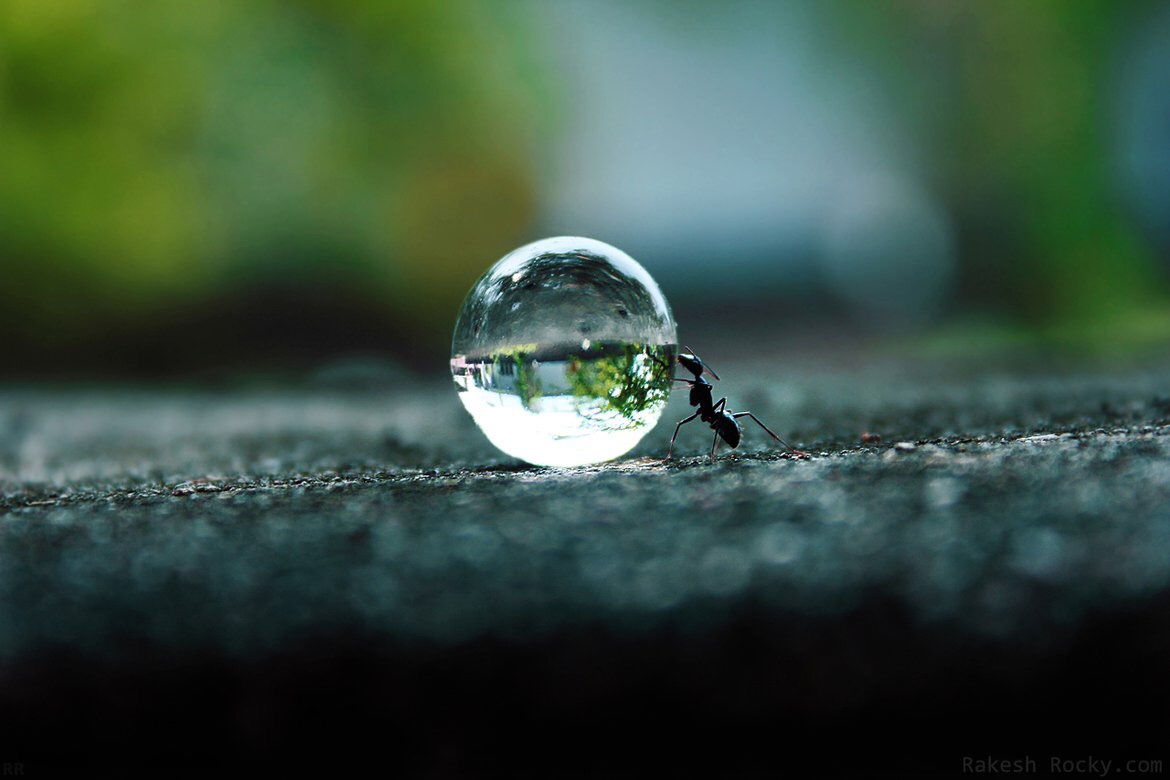
Water reflects the beauty of now. The glassy eye of the water bead displaying its surroundings in a full panorama. The puddle reflecting passers by, life in action.

As human beings we would do well to mimic this behaviour too. To pause in the moment of now. Life comes in these moments of rest, these moments of reflection, these moments of connection with each other and the world we live in. For in one sense this is our purpose.

The cycle of movement will continue, relentlessly. It will happen whether we seek it or not. Just like the water cycle, it will complete. But like the water droplet, we would do well to pause, to reflect the light around us. Ours and that of others.

do we ever stand still?

moving just be
Driving to the station this morning, I passed joggers, cyclists, walkers and of course other cars. I’m on the train now speeding to London.

All around me are people. They’re not physically moving. They’re sitting, standing, temporarily they’re trapped, encased in this rocking rolling glass and steel box, mounted on wheels, planted on rails, transporting us all to work or to some other activity.

As I observe my fellow passengers though, they are still moving. Mentally they are all moving. Books, iPads, laptops, papers, thoughtful looks, animated conversations, all indicators that they are moving, planning, preparing, reflecting, thinking…

On my iPod I’m listening to Rolling Stone by Passenger. The lyrics go … ‘I’m always moving. I never notice because I never stand still’

So true.

When did you last stand still? Just stop? Think of nothing? Do nothing? Just be? Notice only you, your physicality, your breathing, all parts of your physical body – your presence in the world. Your very existence.

It’s an amazing thing. Try it.

image credit: taylormmeredith.com