neat living?

image

I need to cut the grass. It’s a routine during three seasons. Mostly a chore. Weekend job.

We cut a lot of things that grow.

Outside we not only cut grass, we prune roses, clip shrubs, pull up weeds, lop branches.

On our own bodies we clip nails, cut hair, exfoliate skin, pluck eyebrows, shave underarm hair, trim beards or shave them off all together; each day, often at prescribed times.

Most of this cutting seems to serve a tidiness purpose.

But our children grow their knowledge and we cut that too. Don’t do this, don’t say that, run away and play, not now, because I say so… Not tidy. Just timely. For us.

Our own knowledge grows wild, unkempt, organically. We prune that too. Discarding things which might be useful because they’re someone else’s opinion, experience, idea, viewpoint. Tossing our own experiences aside because we cannot find meaning or make sense of it. Often because we don’t have time to. Not tidy. Just timely.

Meanwhile, out of control, inexorably, experience washes over us. And we randomly accept knowledge and learning every day, through every interaction, every experience. Our brains filing it away with dutiful order and precision. Some to be recalled, some to be lost forever in the grey matter. There is no real plan, no real order, no tidy symmetry. Structured randomness.

Unkempt sense making, messy knowing, time restricted learning, disorderly growth.

Neat gardens, neat hair, neat nails, neat lawns, neat children.

Neat lives?

 

what is the value of a thought?

deep in thought

What purpose does a thought serve?

They seem sometimes merely to generate new thoughts, which in turn father more and yet more.

They seem to occupy us. Keep us busy. Deflect us from our experience in the moment.

They seem to be our ticket to our claim of species superiority. World domination. Although recent world events and the erosion of the planet’s resources might argue otherwise.

They seem to be the root of judgement.  Judgement of others. Judgement of ourselves.

They seem to be the foundation of our communication. The exchange of ideas and knowledge with fellow thinkers. Yet two things seem to be true here; firstly, whilst we exchange thoughts we are often distracted from, and dismissive of, our own feelings. The thoughts, and their exchange with other thoughts from other thinkers, perhaps a distraction from an unspoken truth about how we feel. Secondly, our thinking stops us listening.  We are so busy marshalling our own thoughts we don’t really hear the thoughts of those we are supposedly communicating with.

Yet, thoughts seem to be the catalyst for our learning. Generating new awareness, new understanding, new skills.

So I wonder… is the value of a thought always clear?
Is the value worth the cost?
It seems to me… sometimes, but equally sometimes not.

image by: Lisette Wennström

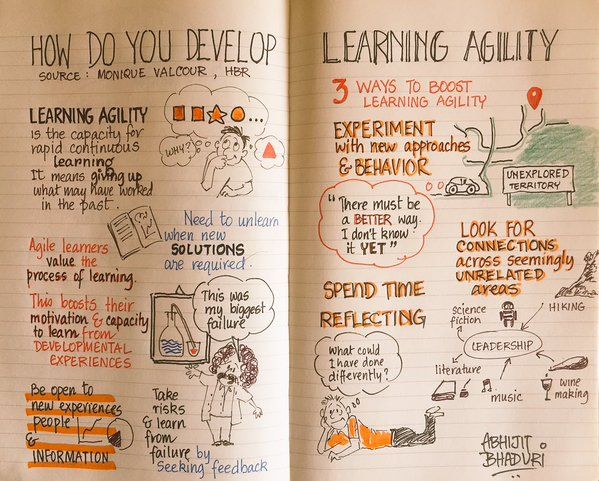
unlearning agility

image

Most teachers waste their time by asking questions which are intended to discover what a pupil does not know; whereas the true art of questioning has for its purpose to discover what the pupil knows, or is capable of knowing.

Albert Einstein

The world is changing at pace.

What we know today may largely be irrelevant in the future. What matters most is no longer what we know, but our ability to learn new things. To keep pace with the changing world.

I wonder if Einstein would have recognised this and modified this wisdom to emphasise ‘…is capable of knowing’ and remove ‘…what the pupil knows’?

Recent research correlates success to our learning agility – our ability to be aware of our experience, be curious, seek feedback, find meaning, learn and unlearn.

Einstein was possibly good at that?

reading between the lines

image

I followed a van the other day.

Its brightly decorated paintwork advertised service, repair and maintenance. I gazed absent mindedly at the contact details. A number and a website.

A Quaking.

Service and repair after an earthquake? Wow, that’s a niche market.

I looked again… and moved the space. Aquaking. “Aqua King” not “A Quaking”.

Misunderstanding and misinterpretation. Sometimes the signs are hard to read. As they can be in life. Our own signs in particular. Learning to read yourself is perhaps the best skill you can acquire. Understand and interpret wisely, for misunderstanding and misinterpreting your own thoughts, feelings and behaviours could cause significant tremors.


green man, red light

walking

I cross a busy junction in London regularly, and noticed something yesterday as I waited with maybe sixty or seventy other commuters.

It’s a pedestrian crossing, so comes complete with red and green men.  The crossing is on a bend in the road. A busy road in Central London.

The traffic lights began to change, amber to red, signalling the traffic to temporarily cease its urgent flow through the arteries of the capital.

Around me, several people urged forward as the red traffic light shone brightly.  Some cast a glance at the vehicles looming down on the crossing, presumably to check that the drivers were obeying the rules of the road. I moved forwards too, moving around someone in front of me; someone diligently waiting for the little green man to shine his instructive self.

Across the other side of the road, the other 50% of the crossing pedestrians were also dividing into two groups for a couple of seconds.  Those who acted upon the traffic signal and those awaiting the pedestrian signal.  A melee briefly ensued as human beings paused, thrust forward, side stepped and chose.

I wondered about motivations.

Rule breakers and rule followers?
Safety conscious and risk takers?
Aware of bigger picture and focused on linear instruction?
Patient and impatient?

How did we divide up and were these behaviours and motivations present in other aspects of each of our human lives?

weirdly new, weirdly human

weirdly new

I’ve just taken delivery of a new car.

It’s the same as my old one.  Same manufacturer. Same model. Same specification. Same colour.  Sure a couple of minor details have changed as they have updated the styling, but essentially it’s the same car.

I’m really excited though.  Strange how the smell of a new car is so good.  I feel like a child at Christmas.

I’ve walked around it several times and lovingly stroked it or removed an imaginary blemish or tiny sign of dirt.

I’m driving carefully too – around a car park, at least.  Strange because it’s the same shape and size, yet I’m being ultra cautious.

Given so little is different.
Given so little has changed.
Why is my behaviour so markedly altered?

How we respond to change.  How our behaviour is connected to our thoughts – real or imagined.  How our senses influence our reactions and our imagination.  Weird, but very human.

they’re your rules, believe it or not

truth

We all have beliefs.

I’m not referring here to spiritual, religious beliefs. I refer instead to the invisible beliefs we hold about the world, about who we are and about what we are capable of.

I’m referring to the truths we hold, sometimes consciously, but mostly out of consciousness, such as “I can’t sing”, or “I’m not beautiful”, or “People are amazing” or “If I set my mind to it, I can achieve anything”, or “I’m stupid”, or “Working hard brings rewards”.

Such beliefs are typically generalisations, typically unconscious patterns, meta to our experience. They can be enabling, or they can be limiting. They act as a post-hypnotic suggestion and they direct future behaviour to confirm them.  They provide context, meaning, causation, structure and as such are irrefutable.  We will deny their inaccuracy, even in the face of cognitive evidence. They are in effect our own personal rules of the world.

Take “Working hard brings rewards”. A generalisation, in that it assumes always. A generalisation in that it doesn’t define work, or how hard, or what rewards? But, someone believing this, will work hard, they will, in all likelihood, value the rewards that work brings and justify or explain those as being earned by the hard work. The ‘truth’ of the belief, or personal world rule, is both acted out now and assumed to be required in future – after all, its truth is without doubt, its cause and effect undeniable, its outcome inevitable – such is the nature of a belief.

Meanwhile, work that doesn’t bring rewards, or rewards unconnected with working hard, may be dismissed as of little note, or simply go unnoticed. The belief could be enabling, in that it provides motivation, the believer will doubtless work hard, will attain and will get rewards. It could also be limiting, in that the believer will probably give up leisure time, family time, time for self and may be pressured with a weight of reward earning responsibility, or may burn out over time.

So what do you believe?  Do you know?

How do your beliefs enable you and how do they limit you?


two ‘i’s in me?

twoismeandyou

Someone today said to me, “I tell myself I should…”

I’m always curious when I hear language like this…

Sentences like “I think I am…” or “I sometimes ask myself…”

In sentences like this we are implying two parts of ‘self’.
They beg the question, “Which I?” or “Who is speaking to whom?”

Not some weird illness generally, but rather a useful indication of some separation within us, often manifesting in an internal dialogue. Integrating these parts, or at least raising awareness of the value arising from their distinction might be useful?


internal finger tips

finger tips

I can feel the steering wheel in my hands. The gloves on my fingers. My skin when I scratch an itch. I can feel my hair through my fingers. My feet on the ground. Sand between my toes. Rain on my face. Sunshine. I can feel my thighs on the chair seat. My arms when they’re folded. I can feel the bag on my shoulder. My knee when it aches. I can even describe the feeling when my toes are so cold I can’t feel them. I can hold something in my hands, blindfold, and probably tell what it is. Its size, shape, texture, hardness, weight…

We are used to feeling. On the outside.

But feelings on the inside are harder. We have less language. Less awareness. Less dexterity in our explanation.

We say things like I’m nervous or I feel good, I feel sick in my stomach or I’m just not feeling too well. I’m happy or I’m anxious or upset. Describing where in our bodies we feel that, and precisely what the sensation is; how the feeling is moving, its temperature, its intensity. This seems harder.

Strange that what our own bodies tell us is more elusive to us than our contact with the external world?

image by: Andreas Roseneder