you can’t tell your story if you don’t know it…

be you be unique

Be who you are and say what you feel, because those who mind don’t matter, and those who matter don’t mind.

If someone took the time to notice you, to see you, to want to read the dust jacket of your story, what would they see, hear, feel and read?

If you could be who you are and say what you feel, what would people experience? What would that experience be like for you?

Do you know?

if I were a malteser…

what this says about me
A few years ago, during some training, I did this exercise. It proved an interesting learning experience and so I offer it to you.

Write down the first three things that come to you. The names of things, nouns, work best. Don’t filter them, reject them as ridiculous, decide to choose a ‘better’ one; just go with the first three things, however seemingly random or crazy.

Now, against each noun in turn, write down the properties of that thing. Whatever you are reminded of by that named thing. The qualities it is best known for. Write down just one or two qualities / properties for each.

Once you have done this, return to each quality and ask yourself, ‘what does that say about me?’ Work through each quality for each named thing.

Now look at what you’ve written, about you.

How much of this is true? How much was known to you? How much was known to those close to you? What is new, what have you learned? What else is true about you? What is missing?

When I did this, many years ago, the three things that came to me were an owl, the wind and a malteser. No idea why, but I’m guessing my subconscious decided those were what I needed.

Of course the properties I chose for those three items, were again probably a subconscious offering, after all I could have chosen many properties. Equally where that led me to, in terms of what that said about me, could have taken me many routes. In point of fact it took me to some things I already knew, deep down, but bringing them to the surface, to my conscious mind, was helpful. It also reminded me of something I had forgotten, or lost, in my journey of life. To see it again was like greeting a long lost friend. But perhaps of greatest use of all, was to see what I had written about me; all together, on the page.

We don’t often write down our most profound qualities. Our deepest truth.

Enjoy. Let me know how it goes – I would genuinely like to hear.

how much is a hug worth?

hug
I read this morning about a Chinese mother selling hugs in an attempt to raise money and awareness to save her four year old daughter, who has leukaemia.

She is selling them for around £1.  It made me wonder what a hug is worth?

A hug at certain times in our lives can mean much. It says hello, it says I’m pleased to see you. It is an expression of intimacy. It says I love you. It also says I’m there for you. It says I acknowledge your existence, I see you and you’re ok. It transmits understanding and empathy. It says don’t worry. It says you’re safe. It says I understand. And much much more. Physical connection, touch, makes us feel good, emotionally, physiologically and psychologically.

Research has shown hugging has an impact on our health, reducing levels of stress and anxiety, reducing heart rates, cortisol levels, blood pressure. It has also been shown to increase levels of Oxytocin, referred to in some circles as the bonding hormone, raising levels of trust and feelings of security.

Of course, reassurance and affection of this kind, through touch, can also come through holding hands, fingers gently entwining. It can come through a stroke of the arm or face. Even meeting eyes, or exchanging a smile can have similar impact. The hug though, seems to be the ultimate. Its level of connection more total, more of us physically in contact with more of someone else, our bodily cores aligned, as one. It pulls our hearts closer together, so that each feels the other beat. It holds our very being, in that moment. It contains our energy, our life source, which, in that moment before, seems in danger of leaking away.

Maybe you can think of a time when you gave someone that gift?

Maybe you can think of a time when that was what you needed. All you needed.

At that moment, what was that hug worth?

I would suggest, priceless.


dance like it’s your birthday

Why born
We celebrated a birthday in our family the other week. Some cake, some cards, a few presents. Nothing grand. I’m sure you do the same. Children’s birthdays are often more lavish affairs, as are so called important or landmark birthdays. These were decided by someone, once. 18, 21, 30, 40, 50 etc… I’m sure any of you celebrating some of these would like to have words with that person.

Our date of birth seems to be important. Yet it has a large element of chance. I wasn’t, but I’m sure if you were, born at one minute to, or one minute past midnight, you might wonder at the possible alternative? We are seldom born on the day we were ‘due’.

Yet our somewhat chance date of birth seems to be important. We are often asked for it as a kind of identifier or label as to who we are.

A relative of mine celebrated the wrong birthday for many years, until they were required to extract their birth certificate and realised they were born on a different day. It hadn’t changed who they were.

Many organisations such as banks, insurers, our employers even, use our date of birth as a key identifier of who we are. At my doctor’s surgery you can sign in on arrival using a terminal. The first question is ‘what is your date of birth?’  The system then presents a list of letters – the initials of surnames – presumably those people of that birth date, registered at the surgery or with an appointment that day?

At school we are batch educated, based on our date of birth. If you happen to be born late in August, you will be in one year group. Born a few days later, you will be in another. We even classify people by decade or period – child of the 60’s, generation z…

Yet our date of birth really says very little about who we are. It says no more than our job title does, or our place of residency, or the university we went to, even the name we were given.

Yet ask someone who they are, and this is often where they start.  “I’m Graham, I’m forty three, I’m a taxidermist, I live in Cippenham with my wife and three children. We have two dogs.” Labels, just like a date of birth, we use to describe who we are.

Try this.  Ask ‘Graham’ again. “Yes and who are you Graham?”  This time you might get something like ‘I’m a family man and I love nature and the beauty of the natural world around us’.

Repeat again. It takes time, but gradually you may find out about ‘Graham’. What matters to him, what he values, what he believes in, his motivations, his dreams and much much more. You might find out who he is.

One of my favourite quotes is by Mark Twain

The two most important days in your life are the day you are born and the day you find out why

What if we celebrated that second day, not the first? Cake and party poppers for something more significant, more real, more impactful on our lives?

It seems to me that requires more celebration. Finding your reason for being, finding out who you are, is to be rejoiced over. Far more than the incidental day you began to breathe.


we like to be seen, but from a distance

see me
How many people do you know?

How many of those do you see, really see?
How many do you allow to really see you?

I’m not talking about visiting, or noticing your new top or knowing how you take your coffee, I’m referring to a deep empathy, a real connection, a knowing so profound it is almost as if they are you, or you are them.

I use the term ‘see’ as a collective here. For some, the term ‘see’ will work. Experiment with alternatives for yourself. How many people really hear you? How many utterly feel you? How many truly get you? How many wholly understand you? How many do all of those things?

It seems we have a deep desire to be seen, to be understood, to be heard. We need to be acknowledged in a human way. Yet to be acknowledged in that total way, can be so desperately intimate.

Intimacy of that sort scares us.

Sometimes the person who gets that close sees more of us than we can see for ourselves.

So we employ tactics to keep ourselves safe, sometimes conscious tactics, but much more often, we employ tactics out of our conscious awareness. Games if you like. Games with ourselves and with those around us. We tease. Here’s a little bit of me, come closer if you dare, come closer if you care. If they do, we often push them away again. That way, we can tell ourselves they don’t really care, or we can shield our vulnerability. If we are the one being being invited in, sometimes that intimacy is too scary too, so we deflect, we joke, we talk about us, we change the subject.

When the invitation is extended, often subtly, often in a fleeting moment, often out of conscious choice … all it takes is to be present. To stand in the moment. If they attempt a game-play or to move away, gently and respectfully, hold them in that moment. Witness their truth. Rather than turn away in a kind of counter game-play, say “I see you (and you’re OK)”, not aloud, but through your presence, your very being. Hold them, carefully, whilst they witness their own truth.

That’s acknowledgement.
That’s seeing them.
That’s deeply human.

what does the map say?

constellation map
If you have a family, you may have heard yourself say something like this…?

“My brother looks to his eldest sister…”
or
“Our daughter is closer to her mum…”
or
“There’s always been distance between me and my brother…”
or
“There was a time when we were close…”

This language seems to suggest that we have an unconscious map inside, not only of the relative proximity of ourselves to other family members, but also their distances and orientations to each other; almost a sense of who is looking which way, where their attention is drawn, where they ‘stand’.

These maps would appear to be deep in our subconscious and in some way describe ‘what is’. They represent a form of truth.

The maps exist in our organisational worlds too. Individuals, teams, departments, functions, divisions can all have hidden relationship maps. Connections that can also exist through time – loyalties and ‘closeness’ to predecessors, founders, old colleagues lost through the last ‘organisational transformation’.

As with families, these maps inform behaviours, present and absent, they provide clues to broken connections, hidden loyalties, deep stuckness.

If you’re feeling stuck and have tried to logically find a way forward, try a different approach to finding a way out.

Build a map.

Decide the context and use a space on your desk to represent it – maybe it’s team dynamics, or the relationship with a colleague, or why the project doesn’t move forward?

Now find something to represent the most important parts. Any object will do, you just need to be able to indicate orientation (where attention is drawn). I sometimes use those little UHT milk jiggers. Place the most significant representative piece. Often this might represent you.

Where are you in this system, and where are you ‘looking’? Take some time to notice this – what does it feel like, what’s true, what’s new to you?

Now place the next most important piece of the map. Trust your instinct, don’t over think. Again take time to notice this piece’s relationship to you, where its attention is drawn. What does this feel like? What’s true? What do you notice?

Build the map slowly. Take time to acknowledge what is, don’t rush to make changes.

This approach is a method related to systemic constellations – a technique for exploring the truth of relationship systems. It was developed from family therapy and is now used in coaching and organisational development.

I recommend some research and a great book by John Whittington, who you can find here
http://www.coachingconstellations.com

Meanwhile, stay curious about your relationship maps and this hidden truth in your subconscious.

have you noticed who has control?

eye_earth


I am me.

In all the world, there is no one else exactly like me.
Everything that comes out of me is authentically mine, because I alone chose it – I own everything about me: my body, my feelings, my mouth, my voice, all my actions, whether they be to others or to myself. I own my fantasies, my dreams, my hopes, my fears. I own my triumphs and successes, all my failures and mistakes.

Because I own all of me, I can become intimately acquainted with me. By so doing, I can love me and be friendly with all my parts. I know there are aspects about myself that puzzle me, and other aspects that I do not know – but as long as I am friendly and loving to myself, I can courageously and hopefully look for solutions to the puzzles and ways to find out more about me.

However I look and sound, whatever I say and do, and whatever I think and feel at a given moment in time is authentically me. If later some parts of how I looked, sounded, thought, and felt turn out to be unfitting, I can discard that which is unfitting, keep the rest, and invent something new for that which I discarded.

I can see, hear, feel, think, say, and do.
I have the tools to survive, to be close to others, to be productive, and to make sense and order out of the world of people and things outside of me.
I own me, and therefore, I can engineer me.
I am me, and I am Okay.

A declaration of self esteem
Virginia Satir

is train travel a metaphor for life?

train signal
My train was delayed the other morning because of signalling problems. If you travel by train they are an ever present fact of life.

The delays gave me time to ponder. Even if you don’t commute by train, signalling problems will be ever present in your life too.  Human signalling problems.

That look …
That sigh …
She hasn’t answered my email …
He’s late again …
Those tattoos …
That outfit …
She smiled …
He’s quiet …
My stomach is churning …

If only life’s signals were as simple as red, amber, green. Stop and go. But in life we interpret the signal. Often incorrectly. Very often.

And the misreading of them, accounts for many of our train crashes, in relationships … with others and with ourselves.

That look means I got it wrong, again
That sigh just proves to me that I’m a boring person
She hasn’t answered my email so she doesn’t care
He’s late again so I don’t matter
Those tattoos mean he’s a thug
That outfit says everything about her
She smiled so she likes me
He’s quiet because he doesn’t agree
My stomach is churning because, again, I’m not good enough

Signals on the train network are there to keep us safe and ironically so are life’s signals.

Our interpretation of the signals allow our beliefs about ourselves and our beliefs about the world around us to remain true. In doing so they keep us safe. They also permit judgement of others and in this way we can attribute our pain and discomfort to them and know we are OK.

Sometimes train signals might serve us better in life. Clear and incontrovertible. No interpretation needed. But then we wouldn’t be human.

So how to avoid the train crash?

What if we just noticed?
What if we communicated?
What if we asked what that signal meant and listened to the reply?
What if we explained how we felt at that moment?
What if we were just curious and had the humanity to have an honest conversation instead of judging and interpreting?

I suspect our relationships would be better – mostly our relationship with ourselves.

Travel well on life’s train journey.

the search for connection and the fear of rejection

connection
A core human need is for connection. Connection to others.  We seek it in many ways.  Soul mates, lovers, friends, family, community …

Another dimension to connection is belonging. We seek to belong, to groups of ‘like-minded’ people, to social groups, ethnic and religious groups, groups of nationality, to teams at work, family and friend groups, communities based around our hobbies and pastimes as well as those where we live. I’m seeking connection in writing this.

Sometimes connection and belonging needs can be met by something as simple as acknowledgement by another. Acknowledgement that we exist. A look, a smile. This affirms our connection to the human race. To be acknowledged by another human being is very precious.

Yet there is a dark side to this search for connection and belonging.  Fear.

Psychologists tell us that fear is adaptive. That it helps us survive. I’ve heard it said we are born with only two fears – the fear of falling and the fear of loud startling sounds – both in service of our survival. I don’t know if that is true.

I have seen fear though.  I have felt it myself.

The fear I see often in my work as a coach and working with the organisational system is the fear of NOT belonging. The dark side of the need for connection and belonging.

This fear stops us speaking up in that meeting for fear of being judged, for fear of being wrong. It stops us talking about our confidence dip or the worries on our mind, for fear of being judged by our boss or our peers. It stops us being who we are, because we’re a little different, unique, special; but that very uniqueness, that ‘not like others’, means we might be rejected. Rejected from the community. So we seek to conform. Because we believe conformity brings connection.

Yet.  Here’s the thing …

When someone you know, tells you their deepest concern, shows their true vulnerability, turns up as their authentic self, how often do you see pure courage?  How often do you reach out and offer support?

Show yourself some compassion and tell your story.  Share your fear. Be who you are. You might find it liberating. You might find it brings you real connection and a stronger sense of belonging than you’ve ever felt.

what if people could hear your thoughts?

Inside me
What if the world was inside out?

Mostly our world is three dimensional.
An outside. A visible shape. An unseen interior.

I watched a young tree the other day blowing in the wind. I could see the sinewy branches dancing to the wind’s tune, waving in a frenetic chorus of communication. I could hear the wind rustling its leaves in an excited chatter. I could observe the trunk bending; flexing to ensure its very survival.

Yet I can’t see inside the tree. The stresses at a cellular level. Damage that might emerge later in life, with a fallen branch or twisted growth. I can’t see the break and heal process as leaves are stolen away by the wind.

Human beings are like this too.

What if the world were inside out?

What if I didn’t see the face you presented; the smile that cloaked the pain? Didn’t hear the words you spoke; the “I’m fine” you mask yourself with? Didn’t notice your visible actions, gestures and behaviours that consciously communicate a message, to unconsciously hide what you really need to say?

If the world were inside out, I might hear your thoughts rather than the words you say, feel your emotions rather than hear your label for them, experience your doubt, marvel in your strength, be transfixed by your beauty, know your vulnerability?

What if I could hear, see and feel your inner truth?

How would it be different?
How would I be different?
How would you be different?

Coming to the world as yourself, as an authentic version of you, requires huge courage and vulnerability. It demands you show a little more of your inside on the outside.

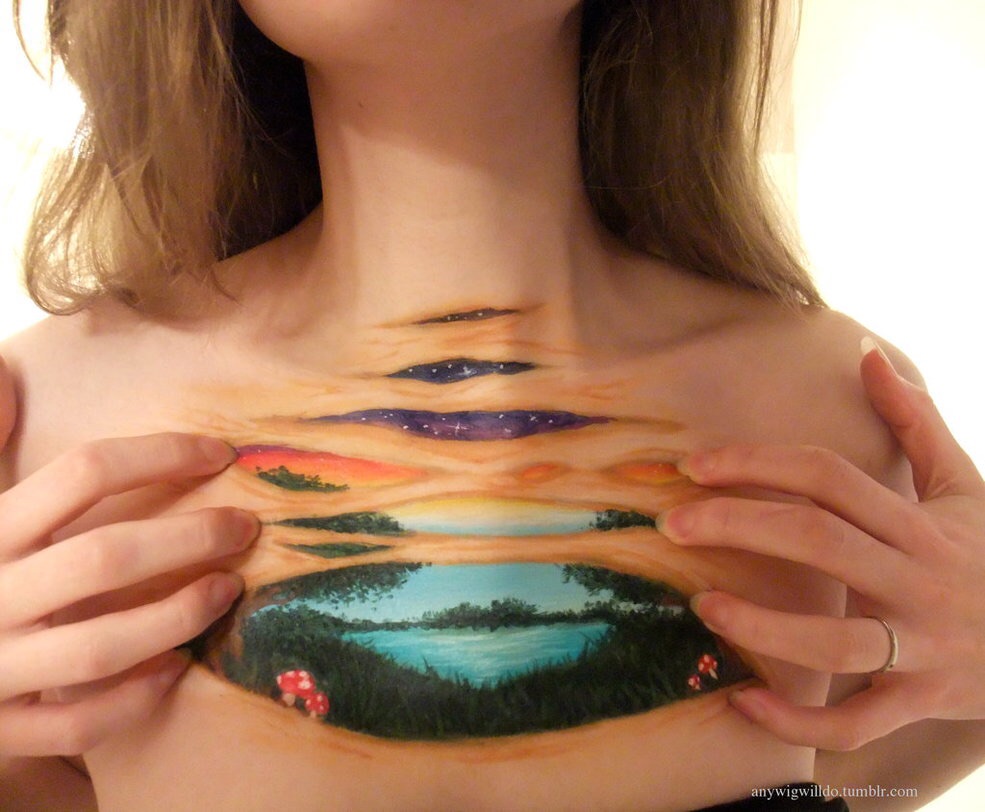
Image of body art by: Pastel-AI