17:9 vision

image

I have reading glasses. I have reached a certain age and my body’s ability to contract the muscles in my eyes sufficiently that I can focus close up, has all but gone.

I used to have what is referred to as 20:20 vision. I don’t know what that means really. My long sight is still superb, but gone are the days I can read the ingredients on a jar without help.

I’m typing this on my phone, so find myself peering down my nose through my reading glasses, looking up and over them when I need to, to see what’s around me or to pause to think.

Two seats away, a man is in reverse. He has glasses too, but is clearly short sighted and is peering over his spectacles at a phone held three inches from his nose. He pushes his glasses up to see me.

Across the train gangway, two men are watching programmes on their tablets. One, a subtitled film. His device is on his knees and he is watching through spectacles. The other, watching Top Gear, has no visual aids but is holding his tablet less than six inches from his nose,

My point is, how we see clearly is different. As it is in our everyday lives.

Some struggle to see what’s under their nose. Some see the bigger picture, but the close up details are blurry. Some like to examine closely. Some only see what they want to.

In life, we don’t have 20:20 vision. We can see some things clearly. Others we are blind to. Even in ourselves. In the mirror, if you will. We are just as blind to others too.  To their value, their outlook, their thinking, their struggles, their joy, their feeling, their intent, their magnificence.

We all need glasses… we just don’t know it.

speaking guttish


When we think, we can tangibly understand and relate to our thoughts. They have a language. Our language. It’s like a conversation. We can hear or see our thoughts. We can reason with them. Disagree with them.

When we think, we can tangibly produce outputs. Pros and cons. Information and data. Benefits and implications. Decisions. Choices.

But when our gut feel is in use, it can be harder to understand and relate to. Often we don’t know what the feeling means. There is no language. In fact we often struggle to find a language for the feeling, let alone interpret its intent for us.

So what does that mean for a decision based largely or completely on gut feel?

The flipism normative decision theory suggests making a decision based on a coin toss. Not a decision based on the toss itself, but on the feeling associated with the outcome. The theory being, if your gut really wanted the ‘heads’ outcome, you will feel positive if that’s the result and disappointed if the toss comes down ‘tails’.

But how do we know a positive feeling from a disappointed one? And what if our feeling on the outcome isn’t ‘disappointed’, but is ‘sad’, or ‘let down’ or ‘futility’ or ‘shame’… How do we interpret a sensation in our body and know precisely what it means? If the outcome our gut seeks is ‘satisfied’, do we know if the feeling is that? What if it’s ‘kind’ or ‘justified’ or ‘rewarded’ or ‘acknowledged’…?

Yet we make gut feel decisions daily. Often these are among our best decisions. The ones we accept readily without a desire to revisit, unlike some of our thinking decisions.

It seems building our language in this area might be useful? Building a way to communicate with our own bodies, helpful?

contrary to contradiction…

image

The well bred contradict other people. The wise contradict themselves.

Oscar Wilde

I don’t claim to be wise, but it amuses me when I contradict myself.

For example, I sometimes catch myself behaving in a way which flies in the face of what I’ve just said. Or saying something that contradicts what I’m doing.

For example, the other day, to allow a group of people to explore learning, we folded our arms, then unfolded them, to fold them again the other way. We were exploring the process of learning and I asked them to reflect and then share their process of learning. I explained there was no judgement. I then asked them to repeat the folding but said, ‘Now fold your arms the wrong way.’ I noticed my use of ‘wrong’ and smiled inside.

We are funny aren’t we?

We are multiple. More than one. Made up of parts. Light and shade. Simple complexity. Surface depth.

human detox anyone?

image

Sitting in Vera’s Kitchen for a cuppa. A fine cafe in Letchworth.

The menu begins with ‘detoxing soup’.

Is that possible? Can soup have a detox effect? What toxin exactly is being removed from your body by consumption of said broth?

Detox, detoxifying, detoxing are ‘a la mode’ at the moment it seems.

But when do we detox our humanity? Remove the toxic parts of our being; the flotsam picked up along our life journey?

The unwanted thoughts. The unhelpful behaviours. The disabling feelings. When do we recover from the self toxifying life journey that has left us with redundant beliefs, self doubt, insecurity, poor self image, vulnerability, limiting thoughts, low self esteem?

That’s the soup we really need.


whose embarrassment?


This morning, two guys standing on the train were sniffing. Each drawing bodily fluid up into their sinuses through the medium of sucked in air. Both sniffing independently. Both once every ten seconds or so. Slightly different rates and slightly different resonance. Together almost musical.

I wanted to hand out tissues.

They were seemingly oblivious to their mildly melodic disruption of my thinking time.

The man next to me produced a silent smell.

It left me pondering what embarrasses us; the actions of others or our own? And who does the embarrassment belong to? Are we embarrassed for ourselves or for others having to judge us?

Why are some of us embarrassed by falling over, having a wardrobe malfunction, nose picking, spot squeezing, breaking wind, going red, messy hair, sneezing … and some of us not?

What is that about? Where does it come from? What purpose does it serve? And whose is it?

wonky is in

IMG_2233

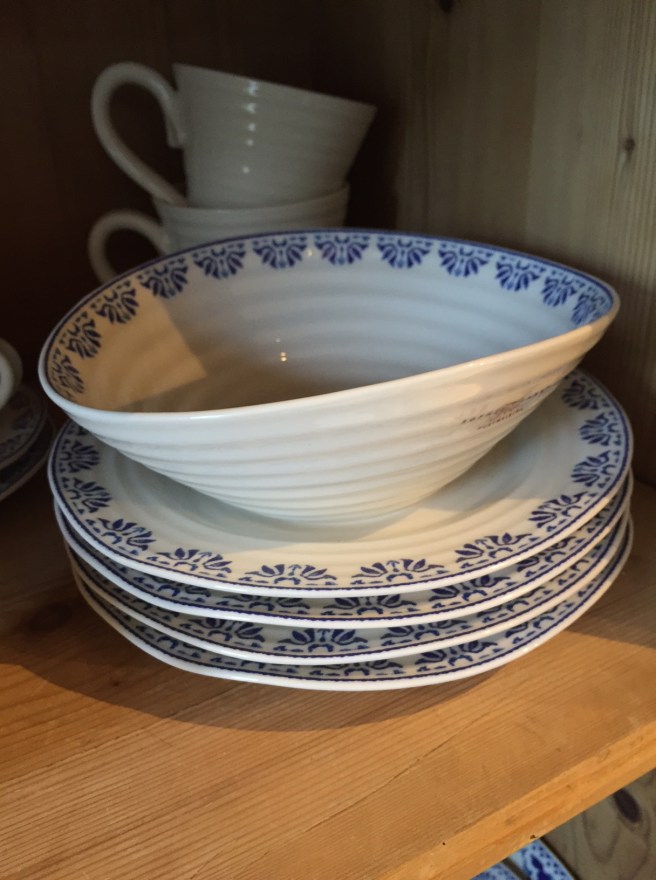
We were browsing a farm shop the other weekend.

I stumbled upon this crockery.  I confess to quite liking it.  Its quirkiness. Its imperfection. Its originality.  Off-set bowls, bendy plates…

Strange how ‘wonky’ is on trend again.  For years our supermarkets have discarded imperfect fruit and vegetables so that we only get straight carrots, nicely shaped ‘nodule-free’ potatoes, uniform apples.  Now, suddenly, it’s OK to have twin parsnips joined at the hip or a slightly more bent cucumber.

Wonky crockery. Wonky fruit and vegetables.

I wonder if we can begin to embrace wonky people?

Wonky because they look different? Wonky because they believe different things? Wonky because they have disabilities? Wonky because they have abilities we (society) forget to value? Wonky because they don’t conform to the cookie cutter of acceptability?

standing in the crowd

image

I’m fascinated by the resurgence of ripped jeans. Clearly on trend, they are everywhere. But let’s just pause for a moment. Who decided to sell us ripped clothes and when did we decide to buy them? It’s not just jeans, Converse sell scuffed up shoes, so that from new, you can have the worn out look. Some designer sneakers are available for $400 with a designer somewhere making hand made tears and marks on your particular shoes.

What next, cars which have scratches in the paintwork? Umbrellas with broken spokes? If the marketeers can persuade us, yes.

If it’s labelled fashion, it seems anything goes. But what does fashion mean?

At the high end it seems to be about breaking new ground. But for the masses, it seems to be about fitting in. About compliance. About peer pressure. Not new; ladies of the Victorian era had their wastes pinched so tight they could barely breathe, in the name of fashion.

Why do we find it so hard to buck the trend? To be individual? To do what we choose?

Or are we in fact doing what we choose?

Choosing to be the same? To fit in? To comply? To seek acceptance? To avoid judgement because others are doing the same? To hide in the crowd?


when losing is actually winning

noeyecontact

The other day I crossed the road, joining the opposite footpath at an elbow. A ninety degree corner in the road.

Coming towards me was a man.
He made a beeline for the apex of the corner.
That was my trajectory too.
We were on a collision course.
I looked at him, trying to read what his decision might be.
We can work this out, together, I urged.
No obvious signals.
No eye contact.
He stared steadfastly at the corner.
I looked straight at him.
Engage me, I said with my eyes.
Let’s work this through.
Nothing
A second had passed.
He stared at the corner.
No eye contact.
Collision seemed imminent.
Inevitable.
I broke my stride.
Created a gap in our flight paths.
He pushed on through.
I passed safely a pace behind him at the apex.
Disaster averted.
Still no eye contact.
No recognition of my existence.

Strange how eye contact allows the other person in. Denying it seems somehow to keep us safe. Protected. No need to feel any responsibility. Any connection. Any trust. Any shame. Any emotion at all.

The man got the corner.

I got more.

the only one real decision

image

You can’t let other people tell you who you are.
You have to decide that for yourself

Recent world events show us how easily individuals can be persuaded.

How the voice of others can tell us what to be, who to be, how to behave. They tell us who is good, who is bad, who is right and who is wrong. When individuals are led by others, they diminish themselves.

In reality we all need to decide for ourselves who we are, what we stand for and how we will live our lives.