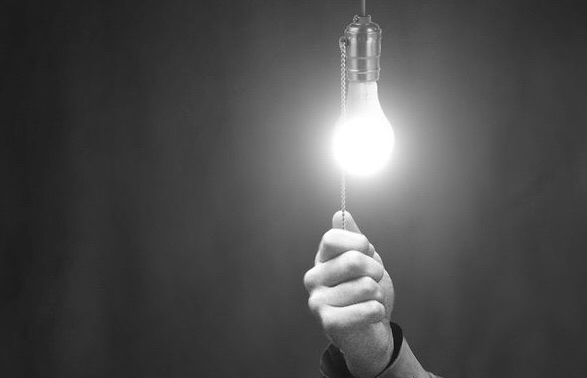
when the power is lost, the lights go out

giving power away
A colleague at work has been leading a new project. She has surveyed the territory, read the research, summarised the viewpoints and gathered the core material. It’s time to document our stance and intended direction.

She invited others to share this work, valuing a collective approach. Now a couple of drafts have been produced, attributed to their shared work, but my colleague is disappointed. Disappointed in herself.

I discussed it with her. The work has lost the essence and the inspiration she found through the research, but also, it no longer reflects her.

We explored how she has given her power away.

We can all do this.

We give our power away when we doubt ourselves. When we try to make everyone happy or look for others approval and validation, thereby over-empowering them.
We give our power away when we fail to honour or share our personal truth. We do it when we compare ourselves to others or worry what other people will think. We do it when we forget that we know what we’re doing and that we are good at it. We do it when we have poor boundaries and allow others emotional activity to intimidate us and leak into our world. We do it when we lose sight of what we need or want, instead placing focus on what we see externally in the world as the blocker – lack of money, time, ability, looks, weight…

But giving your power away diminishes you, disables you, casts your personal light in shadow.

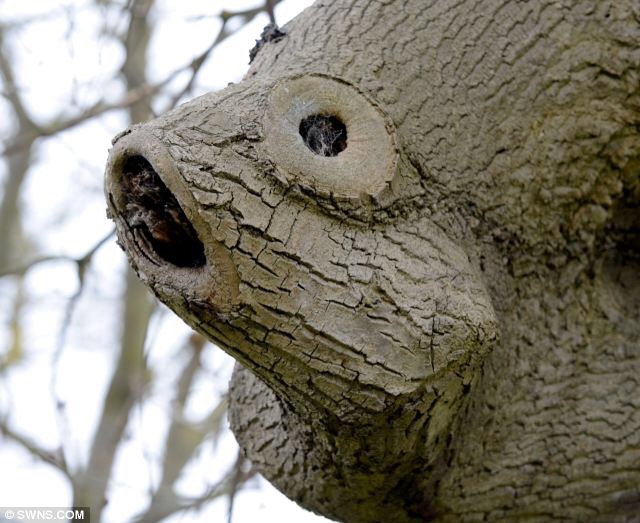
I don’t know, I’m in two minds…

in two minds
As human beings we live in two worlds.

Day to day we interact with the world around us. Work, colleagues, friends and family, engage with us both verbally and behaviourally. We move around in this world, sometimes using mechanical transport, sometimes walking, sometimes aided by lifts, staircases and sometimes running. We engage with inanimate objects, follow daily living routines, complete work tasks, go shopping, read, watch and play on technology…

Then there is the world of our mind and imagination. Here a parallel world exists where people, their actions and words carry an internal meaning and significance. It is a virtual reality that can appear and feel just as real. When it comes to your emotions the virtual world of your mind can often be more real. Our own behaviours and actions have thoughts and feelings attached. The objects we interact with and the movements we make around our world, draw or repel us, enthuse or frustrate us, support or hinder us, anger or please us; they too carry their own significance and meaning, inside our heads and bodies.

So, which world is real?
Which world impacts us more?
In which world does change happen?
Which world, when as we would wish it, offers happiness and fulfilment?

I’m in two minds. You?

Sculpture by Anthony Cragg

what’s in a name?

will i am name identity
Someone I know is a teacher. She teaches in a primary school.

It’s a tough job, but with huge rewards.

The other day she told me about a child in her class. She had noticed he was unable to spell his own name. There were different versions, but mostly incorrect.

Initially surprised at this basic lack she decided to address it. So, after a few weeks allowing him to settle in class and building a relationship of trust, she took the boy aside for twenty minutes at lunchtime one day. They worked step by step, using phonics, using visual recognition, building the letter patterns for the little boy. With practice, time and again he wrote his name correctly.

He left with a huge grin.

Throughout the remainder of the week he was found writing his name everywhere. Inside the front of his book, on the white board, on scraps of paper in snatched moments between the activities of the lesson.

What a gift! The gift of giving this youngster a tangible connection with who he is. His identity. The joy unbounded.

What’s in a name?

Everything, if it’s part of who you are.

the archaeology of you

archaeology of self
What do you think of when I say archaeologist or archaeology?

My first thought is about old things, history, origins.

When I think about the archaeologist I imagine someone, dusty and dirty, on their knees, gently sweeping away at a half buried treasure, using a small hand brush and miniature tools. Occasionally they lean down to gently blow the sand or soil away; the sand or soil that has safely encased and protected the artifact for many many years, centuries even. I also imagine someone piecing together the exposed parts, rebuilding tiny fragments into a more complete whole, something that tells a story.

The art is one of care, of delicate, tender, loving practice. History is treated with the utmost respect.  The finds not treasures of intrinsic monetary worth necessarily, but often priceless in the story they reveal of humanity and community and living long since passed.

It strikes me how this applies to us and our very human being.

Our story, our reality, our truth, our purpose comprised of many small parts formed long ago in our personal history, often buried, safely locked away beneath the surface. If we embark on a journey of self exploration, either for ourselves, or as a coach say in support of another’s quest, the need for that same delicate care, that same respect for what is, that same patience to gently reveal the treasures, would seem paramount.

Just as with the dig and the unearthed pot, often revealing the parts of our human self and then assembling them can reveal something most precious – our layers of significance, our identity, our reason for being, our purpose.

If you seek to explore the archaeology of you, go slowly, blow gently.


a word from the led

leadership a word from the led

And in the end we follow them –
not because we are paid,
not because we might see some advantage,
not because of the things they have accomplished,
not even because of the dreams they dream
but simply because of who they are:
the man, the woman, the leader, the boss,
standing up there when the wave hits the rock,
passing out faith and confidence like life jackets,
knowing the currents, holding the doubts,
imagining the delights and terrors of every landfall;
captain, pirate, confidant and parent by turns,
the bearer of our countless hopes and expectations.
We give them our trust. We give them our effort.
What we ask in return is that they stay true.

The Contract – A word from the led by William Ayot

growing at the edges

learning on the edge
Trees would look strange with spindle-like trunks supporting thick-set heavy branches. New shoots necessarily grow at the tips. Established branches and the trunk, thicken to support this expansion.

My wife and I walked around a housing development site the other day – new houses being built near us. As we walked further in to the development, roads were less complete, houses half finished, before we reached a temporary fence and gate through which we could peek at groundwork for a subsequent phase. New growth building literally on established infrastructure.

Across the country, roads themselves are built at the extremity of existing roads. Sensible really, as a road that is unconnected to the network is pretty useless.

You only have to observe weeds pushing through paving and tarmac to see what power lies at the most delicate tip of the plant. The drive to push through, to break new ground, belying the tender fragility of that new growth.

So too it would seem with our development as human beings. Growth comes at the edge. It builds on what already exists. At first it is new, a little fragile, but gradually with confidence and practice it strengthens and opens up new possibilities for learning and growth.

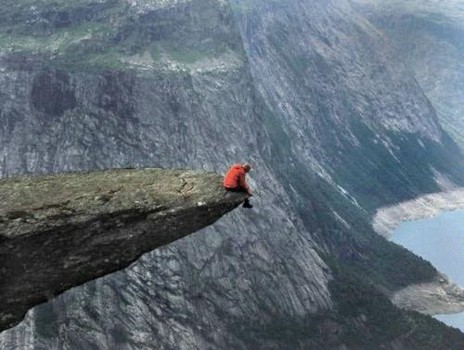
Sometimes we don’t want to go to the edge. It can be scary. A little uncertain. A little too new. We feel vulnerable.

But if we don’t go to the edge, we won’t grow new shoots, expand our capability, learn more about ourselves and our potential.

Stand at the edge of yourself. Branch out. Literally.

facing ourselves is the hardest direction to look

not looking at ourselves
It seems like we stand in the centre of the world.  In the centre of our world.

From this place we can observe all. See sights. See situations. See people. Be drawn towards. Turn away. Fit.

From our vantage point, with our map of the world as the world should be, we can assess everything, place a value on it, judge it. We can rank things, place them in hierarchies of choice, want, need. We can compare this external vista of things, people and their actions with our perception of right and wrong, good and bad.

And we do…

We critique the behaviour, choices, necessities of others. We glance at the unsightly homeless person from the corner of our eye, thereby maintaining a dignified separation. We wince at the teenager’s language and lack of respect in the street, like we skipped that life stage. We place the drunk man in a story, a story of our own creation, so that we can explain his ‘condition’. We assess the parents and their actions towards their screaming toddler, like frustration, tiredness, learning are all experiences we have never had or at least have always handled better. We gossip about the neighbour and the affair we think they’re having, so that we can stay in the ‘moral’ club through our action of placing them in the ‘immoral’ one. We whisper with colleagues about the boss who seems oblivious to the impact of their actions, because there is safety in collusion. We mutter about the Sunday driver who meanders when we’re in a hurry to be somewhere, like they have no intent or purpose.

That person is good, this one less so. We’re OK, because they’re not. How can he do that? Why is she so…? Why don’t they…? I wouldn’t do that. Who wears that? Does she know what she looks like? Really … pink? Why doesn’t he wash his hair? Another holiday!? Why can’t she just say? He’s a waster. She doesn’t realise what she’s doing to him. Amazing, awful, not good enough, disgraceful, shameful, good heavens…

We all do it, every day.  It comes easy. Too easy.

Maybe because in our map of the world, our view of right and wrong, of good and bad, we can be exonerated? We are innocent. Never guilty. We are successful. Never a failure. We are ethically and morally just. Never wicked.

But maybe facing ourselves is merely the hardest direction to look?


what is personal development?

Personal-Development Self Actualisation
The term is well-used. You may, like me, have a personal development plan. The ubiquitous PDP. It seems universally viewed as a good thing, to develop, personally.

But what counts as developing personally? If I go on a time management course, is that developing personally? Is learning to play saxophone developing personally? Maybe I want to learn to practice mindfulness – is that personal development? Is learning to drive? Learning to walk at 15 months even?

Those things would all seem to give me skills. Useful skills that may make me more effective, give me enormous pleasure in my free time, help me be more relaxed or just more mobile and independent.

I’ve been on courses before that were recommended, for my development. Many years ago I attended a negotiating skills course. I remember our trainer talking a lot about children and eating their greens to get puddings. I remember also the horror of being videoed and then made to watch myself back. It didn’t feel like personal development. Training yes, but not development.

So is there something about the development giving me something I want, something of value to me, something that enables me to fulfill my potential, to live my life to the max, as I perceive it?

In order to do that of course I need to know me. What matters to me, who I am, what satisfies me, makes me happy. My dreams and aspirations. Self awareness in effect. But then to be self aware I need to be curious. To want to understand me and how I function, motivate myself, learn, grow. Also to understand how I limit myself. I need to be open to self exploration. Open to self discovery. That way, as I explore myself I can become more self aware.

I also need some sense of my place in the world, what gives me meaning and purpose and how I propose to shape my future to fulfill that. Self realisation in a sense.

So is personal development really about self? About exploration and discovery of self? About awareness of self? About development of self, so that we can be who we think we are? Actualise our sense of self. Complete oneself to the fullest potential?

Maslow talked about self actualisation. I believe he once described it as “intrinsic growth of what is already in the organism, or more accurately of what is the organism itself.”

Is this personal development?