is the SatNav of life working?

image
Driving a car is purposeful. It would seem strange not to have a destination.

Maybe it is home, work, friends, relatives or a visit to somewhere new? Wherever we are going, we normally know the end point before we set out. Indeed we may plan a route. Maps, Sat Nav or simply a route in our heads, recalled from previous journeys perhaps? Or maybe we simply know the key roads and towns and follow the strategically positioned, helpful road signs?

Along the journey, we speed up, slow down, to match the traffic and conditions around us. We indicate turns so that others on different and similar journeys know our intention. We illuminate the way ahead at dusk when we need to see the road to our destination. We may pause en route to resource and replenish ourselves before setting out again to our destination.

Life isn’t like this.

In one, somewhat morbid, sense we know our destination. But in another we don’t. At birth we don’t know our purpose. We don’t know where we’re going. We have no idea of the route our life will take, or of the turns or stops along the way. We can even be half way, or three quarters of the way through our life journey and still not know where we are headed. Sadly some complete the trip and still never knew.

The drive of our lives doesn’t come with maps in the glove box or a Sat Nav on the dashboard. Sometimes we will swerve without indicating, avoiding collisions or steering away from, or towards something. Sometimes we will slow down, or stop, without brake lights for those around us. Life temporarily on hold, or simply crawling in traffic. Sometimes we will make up the route along the way. Sometimes we will turn back. Sometimes we will find a detour. And what if we pause, but don’t like the place we have stopped? What if our way becomes dimly lit, how will we shine a light on the way ahead? What if our vehicle breaks down and we cannot travel to where we wish to be, in the manner or time frame we would want? What if we don’t have the resources, the capabilities, the fuel to reach our destination? Fill up?

We take journeys and driving for granted. Route, provisions, stopovers, movement, fellow travellers, destination.

We have one life journey, yet many of us meander through it.

No aim. No plan. No route. Accepting places we don’t like. Being and doing something, because we don’t know any different, other than to accept it’s just where we are at the moment, on this somewhat aimless journey. Reacting. Swerving. Braking. Turning. Accelerating.

You wouldn’t drive aimlessly. Don’t drive your life that way.

Pay attention to who you are, where you are going, why you are going there and why that matters. Be authentically you. Be purposeful. Be sure when you get to the end, you haven’t gone the wrong way. Relish the journey. Appreciate the views. Value the experience. Enjoy those you meet along the way.

Time to program your SatNav?
 

map your meaning

the-map-of-meaning
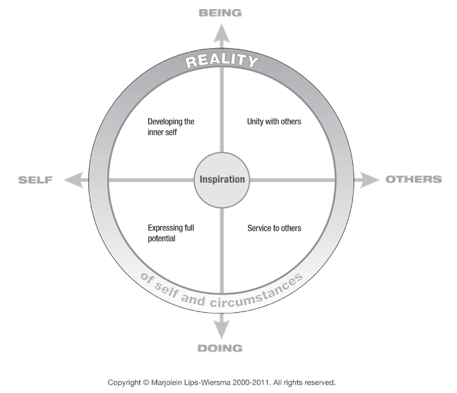
When did you last experience working well with others, maybe with a sense of unity, even if you were quite different? Think of a time.

In that moment, what did you do that helped others? How were you of service to them?

What did you do that uniquely served you? That allowed you to do your best and express your potential?

How was your balance of doing for self and for others?  In balance? Or skewed, maybe as you would want it skewed, or maybe not?

And in that moment, at that time during that experience, what did you realise about yourself that felt important? What part of that experience developed your inner self, such that you might be more you?

How was your balance here between developing and being more you, with that sense of connection and unity from being with others? In other words, how was your balance of being? Were you being more in service of them or of yourself?

Your orientation to being or to doing, balanced with your orientation towards self or to others is interesting.

Does meaning come in one of those quadrants more easily – being (developing inner) self, being (unity) with others, doing (service) to others and doing for self (expressing your potential)?

If so, are there other quadrants which feel less developed? What would you like to pay more attention to?

Mapping where we find meaning can be illuminating.

http://www.holisticdevelopment.org.nz/

time to flex your happy muscle?

happiness mindfulness meditation
For many centuries, great sages, such as Aristotle, Bhudda, Confucius and Epicurus have advocated the pursuit of happiness. They have suggested happiness comes from within, from creating an inner peace, from reflection. Happiness of the mind, rather than of things.

Now science appears to be catching up. I have just been reading about a study at Kyoto University. The research, reported here, has identified a part of the brain, the precuneus, which appears to be larger in people who self declare themselves to have meaning in their lives, who report positive emotional and cognitive experiences and describe themselves as happy. This has been correlated to studies into meditation, which show that the precuneus grows in people who make meditation a part of their lives – it seems that calming our thoughts, being present in the current moment can exercise our happy muscle.

The research speaks of psychological training that could increase the volume of grey matter in the precuneus, which in turn may enhance subjective happiness. The report’s summary says…

Psychological studies have shown that subjective happiness can be measured reliably and consists of emotional and cognitive components. However, the neural substrates of subjective happiness remain unclear. To investigate this issue, we used structural magnetic resonance imaging and questionnaires that assessed subjective happiness, the intensity of positive and negative emotional experiences, and purpose in life. We found a positive relationship between the subjective happiness score and gray matter volume in the right precuneus. Moreover, the same region showed an association with the combined positive and negative emotional intensity and purpose in life scores. Our findings suggest that the precuneus mediates subjective happiness by integrating the emotional and cognitive components of happiness

Time to flex the happy muscle?

Now that’s a happy thought…


where has the magic gone?

#onthemoon metaphor meaning
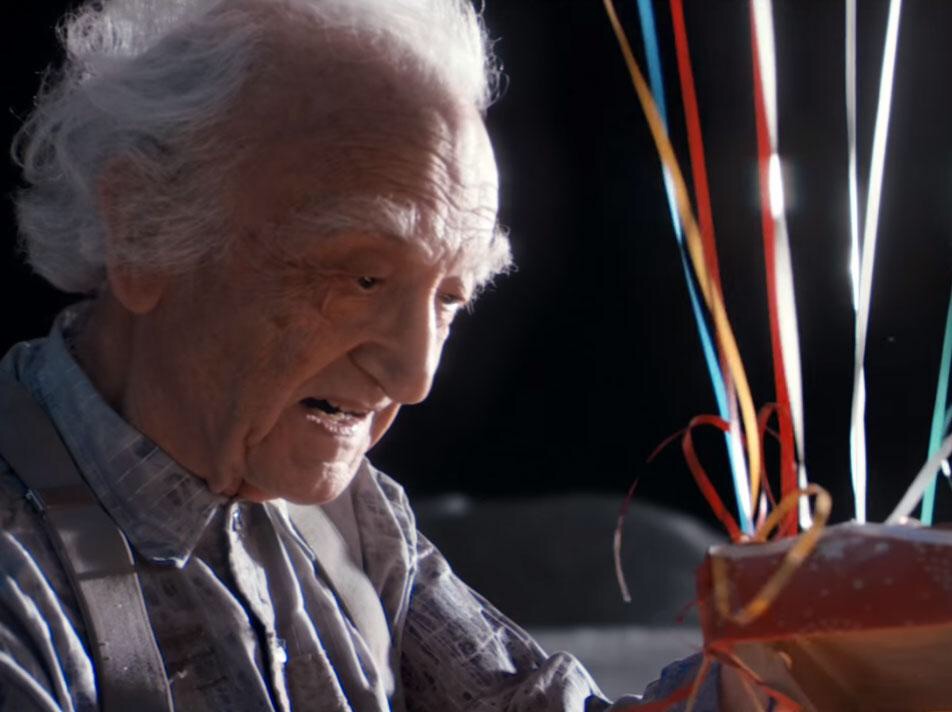
The John Lewis Christmas advert is out. The man on the moon. Its intent is to highlight the loneliness of many old people at Christmas and to champion the concept of giving.

But the scientists, the cynics, the ‘ne’er be happies’, the journalists are already criticising the story. In the Guardian the other day, an article entitled “Who is moon Hitler?” appeared. How can a girl have a telescope that magnifies the moon so well? What is a man doing on the moon in a shack? Is he a banished criminal? How can he breathe? Balloons could not carry a gift to the moon, don’t people understand the physics?…

I wonder, have we lost the magic of metaphor? Where have the dreams gone? Does humankind not draw inspiration from the improbable any more? How do we progress without imagination? Where on our journey did we lose that childhood gift?

I have been with a number of people who, on seeing the advert, have shed a tear. Of course they have. As I was discussing here the other day, meaning making is an inherent human need and this beautiful piece of cinematic art gives us meaning. It connects us to our emotions. It reminds us of family, of loved ones, of Christmas, of being alone and of loneliness. That creates meaning for us.

John Lewis is being commercial, naturally. The advert is not entirely altruistic. But its association with Age UK is intended to highlight the number of people, particularly old people, who will feel loneliness this Christmas. A worthy human cause.

Notwithstanding the commerciality, the charitable intent and the human story though. Surely, even in a commercial, money driven world, there is space in our humanity still for hope, for imagination, for a wonder delivered through the magic of metaphor? If not, then as human beings we have fallen far.

We should look to our children, where magic and wonder still thrive. Where story and metaphor is still rich and wondrous, filled with meaning. Where experimentation and imagination fuel learning and growth. As adults we would do well to reconnect with the child in us.

Otherwise, where has the magic gone?

making sense or making meaning?

making meaning making sense
Is there a difference for you between making sense of something and making meaning?

For me, making sense is largely, though not completely, a cognitive process. It’s one that facilitates understanding. It is how I comprehend things in the world around me.

So, if I look at the picture above, I might deduce that this is a teddy bear, that this teddy bear looks soft. He is brown. I know that teddy bears are toys, that often children have them. I might make sense of this teddy bear as a child’s teddy bear. A bear that has been posed to cover his eyes. Equally I might understand that teddy bears can be adult gifts to reflect tenderness, affection, love. I might be curious about the teddy bear’s size, because I know bears come in many sizes, and without background in the picture to contextualise and offer perspective I have to surmise whether it is small or large.

Making sense in this way is how we exchange and gather knowledge about our world, how things work, how to use them, their purpose.

Meaning making and seeking meaning however are inherently human processes at the heart of our humanity. Making meaning facilitates significance. It bonds us to our purpose and sense of self and creates a richer, deeper connection than simply understanding, or making sense. It highlights patterns to aid with new learning, new connections and systemic thinking. It stirs our emotions. It connects us to our experience, our memories, our values, our personal story. In short, it makes us human.

So, for me, the bear picture might remind me of my own teddy bears from my childhood. I might connect to the memories of my own children and their lives now as young adults, way beyond the teddy bear years. I might notice the teddy bear makes me sad and I might recall other times I have been sad. It might equally remind me of happy times. It might remind me that I too sometimes hide. Or that I like a hug. It may bring back memories of parents, of childhood games, of key events in my human story.

In this way meaning making is important. It connects our world experiences, our interactions to people, to activities and to things with our own sense of self. It connects us to our memories, and to our personal story through a deeper somatic awareness. It is more impactful, but also more useful, in that it enables us to form both new and tangential connections, which offer new learning, new meaning and new possible futures.

I can be taught to understand the world around me, to make sense of it, but making meaning of it is a very personal experience.

Maybe it’s the same for you?

the archaeology of you

archaeology of self
What do you think of when I say archaeologist or archaeology?

My first thought is about old things, history, origins.

When I think about the archaeologist I imagine someone, dusty and dirty, on their knees, gently sweeping away at a half buried treasure, using a small hand brush and miniature tools. Occasionally they lean down to gently blow the sand or soil away; the sand or soil that has safely encased and protected the artifact for many many years, centuries even. I also imagine someone piecing together the exposed parts, rebuilding tiny fragments into a more complete whole, something that tells a story.

The art is one of care, of delicate, tender, loving practice. History is treated with the utmost respect.  The finds not treasures of intrinsic monetary worth necessarily, but often priceless in the story they reveal of humanity and community and living long since passed.

It strikes me how this applies to us and our very human being.

Our story, our reality, our truth, our purpose comprised of many small parts formed long ago in our personal history, often buried, safely locked away beneath the surface. If we embark on a journey of self exploration, either for ourselves, or as a coach say in support of another’s quest, the need for that same delicate care, that same respect for what is, that same patience to gently reveal the treasures, would seem paramount.

Just as with the dig and the unearthed pot, often revealing the parts of our human self and then assembling them can reveal something most precious – our layers of significance, our identity, our reason for being, our purpose.

If you seek to explore the archaeology of you, go slowly, blow gently.


what is personal development?

Personal-Development Self Actualisation
The term is well-used. You may, like me, have a personal development plan. The ubiquitous PDP. It seems universally viewed as a good thing, to develop, personally.

But what counts as developing personally? If I go on a time management course, is that developing personally? Is learning to play saxophone developing personally? Maybe I want to learn to practice mindfulness – is that personal development? Is learning to drive? Learning to walk at 15 months even?

Those things would all seem to give me skills. Useful skills that may make me more effective, give me enormous pleasure in my free time, help me be more relaxed or just more mobile and independent.

I’ve been on courses before that were recommended, for my development. Many years ago I attended a negotiating skills course. I remember our trainer talking a lot about children and eating their greens to get puddings. I remember also the horror of being videoed and then made to watch myself back. It didn’t feel like personal development. Training yes, but not development.

So is there something about the development giving me something I want, something of value to me, something that enables me to fulfill my potential, to live my life to the max, as I perceive it?

In order to do that of course I need to know me. What matters to me, who I am, what satisfies me, makes me happy. My dreams and aspirations. Self awareness in effect. But then to be self aware I need to be curious. To want to understand me and how I function, motivate myself, learn, grow. Also to understand how I limit myself. I need to be open to self exploration. Open to self discovery. That way, as I explore myself I can become more self aware.

I also need some sense of my place in the world, what gives me meaning and purpose and how I propose to shape my future to fulfill that. Self realisation in a sense.

So is personal development really about self? About exploration and discovery of self? About awareness of self? About development of self, so that we can be who we think we are? Actualise our sense of self. Complete oneself to the fullest potential?

Maslow talked about self actualisation. I believe he once described it as “intrinsic growth of what is already in the organism, or more accurately of what is the organism itself.”

Is this personal development?

making meaning from now

making meaning from now
The concept of ‘now’ intrigues me.

I have always considered myself someone who is very present, in the moment, in the ‘now’. But reading something in a book by Steve Chapman the other day, gave me a different language to describe it. This is what I took from what I read…

Time as we know it, is a social construction, a human invention, something that over many centuries we have honed and agreed universally as a good way of orienting ourselves to movements of the solar system, and to getting to our next meeting on time!

The most obvious ever-present reminders of the concept of time, are the clock and the calendar.  These have developed over centuries from lunar calendars to solar calendars, sundials etc… to, I guess, the i-watch.

This clock time, or chronos time – the on going perpetual march of seconds, minutes, hours – ticks away on our watches, clocks and electronic systems all over the world.

Daniel Stern argues that if chronos time were real, then the moment of ‘now’ would be so fleeting that we would never be able to dwell on it long enough to make meaning of the experience.  We would in effect be goldfish, with each ‘now’ moment lasting +/- one second; the unit of chronos.

The Greek concept of kairos offers an alternative perspective. Kairos is a moment of indeterminate time in which everything happens. While chronos is quantitative, kairos has a qualitative, permanent nature. In kairos there are no seconds, minutes, hours, just the idea that kairos time is a passing moment of consciousness, in which something happens that offers us new meaning in our experience.

The author of my book summarises the two like this…

chronos time is a concept informed by clocks
kairos time is a concept informed by meaning

What would happen in organisations if we abandoned chronos time and just interacted, communicating, learning, until a new collective meaning emerged?

Meetings wouldn’t have agenda items with start and end points, but each item would be explored until collective new meaning emerged. Some agenda items might take five minutes, some items ten times as long.

Of course for this to work, people need to be open to learning, open to having generative conversations, open to enquiry with others as to where collective meaning existed, or was lacking.  People would need to be very present in this ‘moment of meaning making’. No longer slaves to chronos time, people would interact throughout the day until sufficient meaning had emerged for individuals to move forward, for the business to move forward.

In such a kairos informed culture I wonder if this would make us more curious, more exploratory, more accepting of alternative viewpoints and enable us to both seek meaning in our work and in our lives? It might also free us to play with our creative spirit.

What would happen if we lived our lives to kairos time? Not just at work, but all our experiences?

Even as you read this, you may be seeking to find new meaning for you?

Welcome to kairos 🙂

What is your journey?

journey
What is your life journey?

Is it a saunter along a meandering woodland path? Is it a route march along a Roman road? Is it an invigorating swim across an extensive lake? Is it a breathtaking parachute descent from 30,000 feet? Is it a dizzying playground roundabout spin? Is it a race down the motorway? Is it a steady climb up a long spiral staircase? Is it a lazy river float? Is it an absail down a deep rugged ravine? Is it an underground exploration? Is it the soaring glide of an eagle over mountains? Is it a scramble down a rough rocky track? Is it a sightseeing bus ride through an unfamiliar city? Is it a run through the surf on a sunset beach? Is it a speeding train ride through a blurring countryside? Is it a tightrope walk over a cavernous gorge? Is it a deep dive from a towering cliff top into a deep green sea? Is it a horseback gallop through a never ending desert? Is it a precarious rope bridge crossing over a river torrent?

What is your life journey?