separation

  
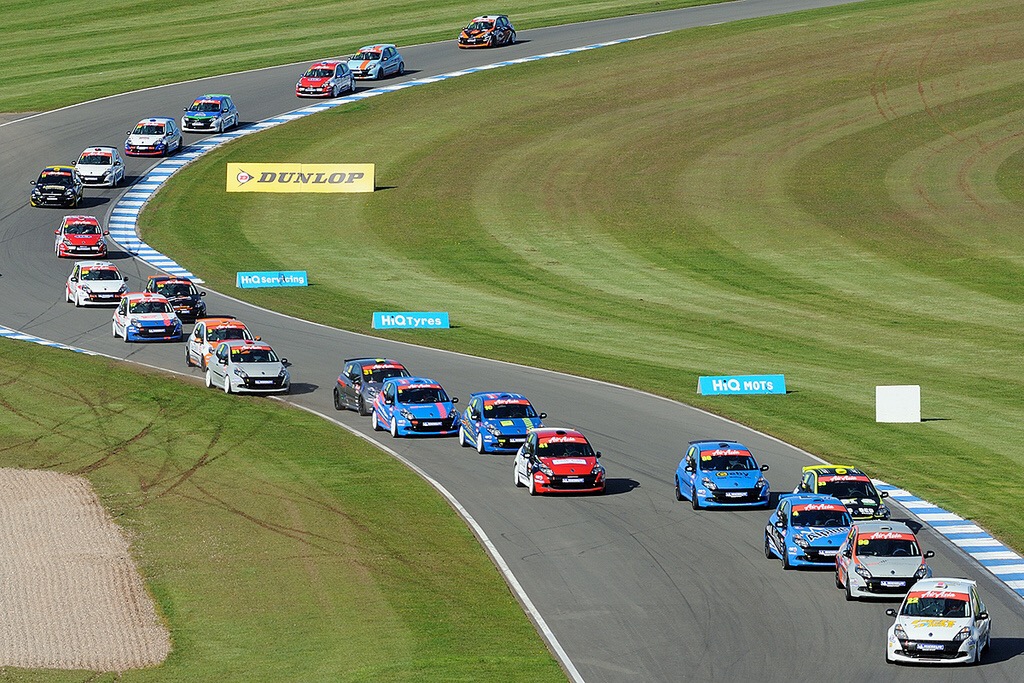
Watching Motorsport at Donington Park today.

I’m sitting on a hill in the infield looking at the old hairpin. Cars are weaving down the Craner Curves, jostling for track position into this all important corner.

Meanwhile, I’m listening to the race commentary on the circuit app on my phone. The commentary covers the action elsewhere on the circuit. So I can listen to the incident at Redgate where two cars have entered the gravel trap.

When we go racing we take a camping stove and I’m tucking in to a freshly made egg and bacon roll. The soft yoke has just exploded across my fingers. The smell and taste a sensory delight.

The sun is warming my right ear.

I’m struck by my ability to separate my senses. To see one set of action, hear another, feel the sun and direct my olfactory and gustatory senses to a stomach welcoming culinary classic.

Maybe separating our senses is easier than focusing them all on the same experience? We do it every day.  I do wonder what I’m losing as a result though?

don’t be disappointed but…

image

I received an email today. I was one of a number of recipients. It started…

“Don’t be disappointed, frustrated or any other negative emotion please, but…”

Until I read that, I wasn’t.

Upon reading it though, I am well prepared to take on any number of negative emotions, even before I get to understand what I am going to have to get emotional about.

My state, my intent has been pre-programmed by the writer, if you will.

Ironic really.


work or play?

image

I must finish my work before I can play

or

I can play anytime I like

Which of these is more you?

Often when I ask a room of people to make their choice, the room divides.

Those choosing the former, talk of not being able to enjoy their relaxation or play until the work is done. The list of jobs needs to be ticked off. Completing the work is in itself enjoyable. The play is a reward for completing the work. They sometimes mention responsibility or duty.

Those choosing the latter, talk of performing better when they have had down time, play or relaxation. They speak of choice. They describe making work into play, to increase their enjoyment.

Occasionally someone stands between the two, recognising a different stance in different circumstances, such as work or home.

I’ve never experienced someone not knowing.

I don’t recall the lesson in school where we learned this? I don’t recall the conversation with mum or dad, where they explained the pros and cons or the virtues of each approach?

It seems we just know. Somehow in life, we have learned through experience. That learning is often so well ingrained we don’t even see a possible alternative. It just is.

There are many opposites like this, not just work and play, where we have a position, a life stance. Many, I suspect, we have never been consciously taught which is best, we have just absorbed this into our existence, our way of being.

Weird eh? Enabling sometimes, disabling at other times. Strange that such life impacting choices seem invisible, out of conscious awareness. They just are.

reading between the lines

image

I followed a van the other day.

Its brightly decorated paintwork advertised service, repair and maintenance. I gazed absent mindedly at the contact details. A number and a website.

A Quaking.

Service and repair after an earthquake? Wow, that’s a niche market.

I looked again… and moved the space. Aquaking. “Aqua King” not “A Quaking”.

Misunderstanding and misinterpretation. Sometimes the signs are hard to read. As they can be in life. Our own signs in particular. Learning to read yourself is perhaps the best skill you can acquire. Understand and interpret wisely, for misunderstanding and misinterpreting your own thoughts, feelings and behaviours could cause significant tremors.


reality blind?

We have seen this road sign many times – it is familiar as an image.

We don’t need to read the sign. We are conditioned to know red means stop. The words are somehow irrelevant.

We have seen this context too. Roadworks, queues, lights, single file traffic…

So, if this sign said, “WHEN GREEN LIGHT SHOWS WAIT HERE”, would we stop? Probably not.

I wonder how often in life do we ignore what we are being told, verbally or visually, because we have been programmed to create our understanding, our awareness, by what we have experienced before?

How often might we delete, distort or generalise the information, because our programming  tells us what we need to know?

In reality, how blind are we to reality?

weirdly new, weirdly human

weirdly new

I’ve just taken delivery of a new car.

It’s the same as my old one.  Same manufacturer. Same model. Same specification. Same colour.  Sure a couple of minor details have changed as they have updated the styling, but essentially it’s the same car.

I’m really excited though.  Strange how the smell of a new car is so good.  I feel like a child at Christmas.

I’ve walked around it several times and lovingly stroked it or removed an imaginary blemish or tiny sign of dirt.

I’m driving carefully too – around a car park, at least.  Strange because it’s the same shape and size, yet I’m being ultra cautious.

Given so little is different.
Given so little has changed.
Why is my behaviour so markedly altered?

How we respond to change.  How our behaviour is connected to our thoughts – real or imagined.  How our senses influence our reactions and our imagination.  Weird, but very human.

they’re your rules, believe it or not

truth

We all have beliefs.

I’m not referring here to spiritual, religious beliefs. I refer instead to the invisible beliefs we hold about the world, about who we are and about what we are capable of.

I’m referring to the truths we hold, sometimes consciously, but mostly out of consciousness, such as “I can’t sing”, or “I’m not beautiful”, or “People are amazing” or “If I set my mind to it, I can achieve anything”, or “I’m stupid”, or “Working hard brings rewards”.

Such beliefs are typically generalisations, typically unconscious patterns, meta to our experience. They can be enabling, or they can be limiting. They act as a post-hypnotic suggestion and they direct future behaviour to confirm them.  They provide context, meaning, causation, structure and as such are irrefutable.  We will deny their inaccuracy, even in the face of cognitive evidence. They are in effect our own personal rules of the world.

Take “Working hard brings rewards”. A generalisation, in that it assumes always. A generalisation in that it doesn’t define work, or how hard, or what rewards? But, someone believing this, will work hard, they will, in all likelihood, value the rewards that work brings and justify or explain those as being earned by the hard work. The ‘truth’ of the belief, or personal world rule, is both acted out now and assumed to be required in future – after all, its truth is without doubt, its cause and effect undeniable, its outcome inevitable – such is the nature of a belief.

Meanwhile, work that doesn’t bring rewards, or rewards unconnected with working hard, may be dismissed as of little note, or simply go unnoticed. The belief could be enabling, in that it provides motivation, the believer will doubtless work hard, will attain and will get rewards. It could also be limiting, in that the believer will probably give up leisure time, family time, time for self and may be pressured with a weight of reward earning responsibility, or may burn out over time.

So what do you believe?  Do you know?

How do your beliefs enable you and how do they limit you?


two ‘i’s in me?

twoismeandyou

Someone today said to me, “I tell myself I should…”

I’m always curious when I hear language like this…

Sentences like “I think I am…” or “I sometimes ask myself…”

In sentences like this we are implying two parts of ‘self’.
They beg the question, “Which I?” or “Who is speaking to whom?”

Not some weird illness generally, but rather a useful indication of some separation within us, often manifesting in an internal dialogue. Integrating these parts, or at least raising awareness of the value arising from their distinction might be useful?


meta to the meta

image

Meta tags appear on web pages. They aren’t visible to the reader, they contain data describing the page. Data on the data, if you will. ‘Meta’ can also be described as a concept which is itself an abstraction from another concept.

Going ‘meta’ to a situation can also be a self referential place; stepping outside of oneself to observe oneself.

An example might be to ask “What do I think about my thinking?” Or perhaps to explore, “How do you reflect on those reflections about that?”

Sometimes, creating a different physical perspective can help still further. Try this out…

Sit and think about a problem or issue you are currently grappling with. Notice what you’re thinking and feeling as you explore this difficulty.

Now, get up and stand across the room, looking at the original chair or place you were just in. Here you are no longer thinking about the original problem, instead you are considering the thinking about the problem.

Ask yourself “What do I notice about that thinking?”  Ask yourself “What do I think and feel about that thinking and what do I hear in that thinking?”

Notice what comes to mind. Perhaps you think the thinking was a little negative or judgemental? Maybe you notice uncertainty or confusion? Maybe you notice more than one perspective in the thinking – like an internal dialogue? Notice whatever comes to mind?

Now, stand in a third place; another part of the room, still further from the original chair. This time look at the place where you were standing a few moments ago; the second, reflective place. From this new third place, ask yourself “what do I notice, what do I think, how do I feel about that thinking in that place?” The thinking about the thinking, if you will.

Here you may find new insights. New meaning. New significance. New awareness on the original issue… as you go meta to the meta.


mindless thinking?

image

The mind’s job is to validate what it already thinks

Byron Katie

Sometimes we fool ourselves into thinking we are thinking. That we are using our higher cognitive capabilities to make choices, rationalise, decide. To use our intellect.

Our minds are perhaps the best pattern forming device we know. So once a pattern is there, we usually lose the ability to think around it. Instead our brain tells us what it believes it already knows. It post rationalises so as to prove its pattern is correct.

Something to think about?