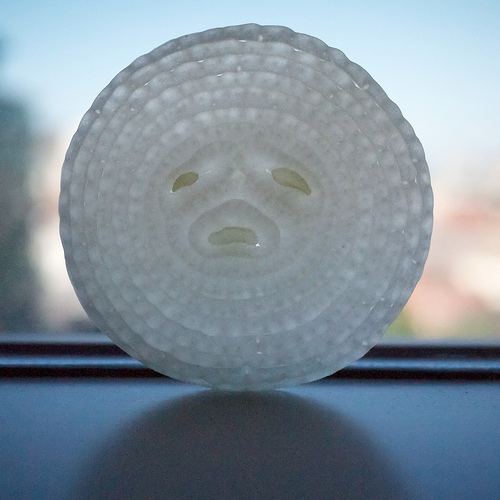
do onions really smell?

image

“Ogres are like onions.”

In the movie Shrek, the ogre is walking with Donkey through a field. Shrek is trying to describe his complexity. “Ogres have layers” he continues. Donkey doesn’t get it and wonders if Ogres are like cakes, because they have layers too and more people like cake. It’s an amusing, but deeply human moment. The analogy of a simple vegetable revealing real human depth, in an ogre. But as in many of today’s great children’s animations, there are messages, metaphors, analogies for the adults.

And… we are all like onions.

Layers of complexity. People we meet will see the outer layer. Those who look deeper may see what lies in the next layer down, or even the one beneath. If we pay attention to people and really take the time to notice, we can all see layers of their complexity and a depth of ‘human being’ in those we meet. We can never see it all though – even in those we are closest to.

We, in turn, may let friends, and those close to us in. Sometimes sufficiently to see the three, four, five layers beneath the outer layers, but there may be a core we don’t let anyone in to see. We may not even know ourselves what lies at the heart of our humanity, our self, our soul. What we are really made of, capable of.

Experiences can reveal our own layers to us. Sometimes difficult experiences, moments of conflict, moments of pain, moments of personal challenge. These can reveal deeper truths to us, but only if we take the time to notice. Only if we are resourceful enough in the moment to learn. And often we are not.

We need to be curious about ourselves, take time to notice, be compassionate with ourselves, learn to reflect, give ourselves time. And we need to recognise the times when we are avoiding the difficult learning, by telling ourselves that well trodden story we have always told ourselves. We need to look for our true truth. Learn to learn. About ourselves.

An onion flavours our cooking.

Your layers flavour you.

what is your relationship to space?

space freedom
I’m on a train. If possible, when on a train I sit in the aisle seat.

This typically requires another passenger to ask me to move if they seek to occupy the window seat. I notice I encourage this need to ask.

Now, I’m not a selfish person. I like other people and I will often go a long way in support of their needs.  I will always move to allow seat access and only last week I moved completely to allow four ladies to sit together around a table booth on the train.

Still, I like the space of the aisle seat. I don’t like being trapped by the window. Dependent on another moving for me to move.

This afternoon I’m reflecting on the clearly higher priority I place on space and freedom, and possibly control, over compassion and kind nature towards fellow humans.

It appears to be my truth though.

I like space to think too. Space around me when I’m coaching. Physical space at work and at home. I like walking in open spaces. But beyond this I don’t like to be constrained by others. Physically, mentally, emotionally, creatively. Pretty much any dimension actually. Never ask me to do something and then prescribe how I should do it. For me, this is another manifestation of constraint or removal of space and freedom.

What is your relationship to space?
To freedom?
To being unconstrained?

And how does this manifest for you? How do you experience this relationship with space?


when the solution we seek stops us seeing

image

Freedom from the desire for an answer is essential to the understanding of a problem.

Jiddu Krishnamurti

This seems relevant in the context of recent world events. Our desire, and that of our leaders, to fix the current situation seems to blind us to the true nature of the problem. We must take action. Seek a solution. Find an answer.

What if we sought understanding? What if we employed curiosity? What if we questioned to heighten awareness, rather than to judge?

It seems this is a reflection of our society. The pace of change. The need to know, and to know now.

Contemplation. Reflection. Awareness. Stillness. Compassion. Humanity. These might be everyone’s ally.

#prayforParis

what is your psychological contract of self?

psychological_contract self
Psychological contracts are often referred to in the context of the employer and the employee – what is the expectation, commitment of both?

It sometimes explores qualities of trust, honesty, respect, fairness, compassion. It will often cover the visible expectations and agreements, such as pay, hours, work, training, but more usefully might look under the waterline, beneath the visible iceberg, so to speak. Here might be give and take, inputs and outputs, responsibilities and rewards which are less clearly in play. Concepts such as control, power, innovation, recognition, commitment, respect, loyalty, tolerance and much much more.

At a meeting the other day we were discussing psychological contracts. We were to be a team, so the question posed was, ‘How did we want to be with each other?’

We were to discuss what we were looking for from other members of the team, what we were seeking from the team leader and what we would bring to the team. What our commitments would be in terms of contribution and what we were seeking in return.

As I reflected, I wondered how I could even begin to answer this, as my thoughts and feelings were initially directed inwards, at me. I wondered what my psychological contract with myself was?

Did I respect myself? Did I have compassion for myself? Did I have faith in myself? Was I in control of myself? Did I fully trust myself? Did I appreciate my own being? Did I own my own power?

What are my perceptions of myself, what do I believe about myself?

How am I getting in my own way, either unaware of, or maybe breaking, my own psychological contract even before I entered the room. Surely this is where I should start before considering any team working agreements?

What is my psychological contract of self?

are you sure you want to read this?

are you sure reflection
The “Are you sure?” button can be annoying.

You’ve done your preparation, made your decision and having pressed ‘send’ or ‘ok’, ‘cancel’ or ‘order’ the screen provides another pop-up asking the “Are you sure?” question.

Grrr.

This week I have had to cancel a holiday. Flights, hotels the lot. Each step I have been asked the “are you sure?” prompt. It has given me a moment to honour the importance of reflection, to honour a sadness, but also to honour the decision, other values that matter to me, people that matter to me.

I wonder, what if that button existed within us? What if when we were feeling fed up, the “are you sure?” prompt encouraged us to check in, calibrate and consider what is good in our lives?

What if when we were about to be overtaken by anger, the “are you sure?” prompt offered us the opportunity to pause, breathe and get some perspective?

What if when we were about to say something inappropriate in the midst of an argument, something that we might later regret, the “are you sure?” prompt held the words in the departure lounge of our minds and mouths, giving us a moment to re-think and consider the consequences?

What if when we felt a wave of emotion and our heads stepped in to prevent that showing to the outside world, the “are you sure?” prompt gave us the chance to be? The chance to show vulnerability and our truth? To be real?

Last week I might have signed a petition to ban the concept of “are you sure?” but now I’m asking myself “are you sure?”

the shadow cast by judgement

shadow judgement
I was struck the other day by two meanings for the word judgement.

In a meeting we were lamenting the loss of a capability to make judgement calls. The ability to hold uncertainty. How rules, laws, policies etc have made us over sensitive to getting it wrong.  What’s the ‘right way?’ we ask. Our risk averse nature in an essentially critical world would seem to make the art of judgement a difficult tool to handle.

In a separate conversation we were discussing the dangers of judgement. The judgement we all make about other people and about ourselves. The way, in an increasingly diverse and inclusive world, we still jump to conclusions about people and equally get stuck in our own patterns of judgement about ourselves.

Wanting greater judgement, yet at the same time challenging its use.

I looked to the dictionary.  The relevant definitions are “the ability to make considered decisions or come to sensible conclusions” or “an opinion or conclusion”

Perhaps that’s the point?  One misses the ‘considered’ or ‘sensible’.  Jumping to an opinion or conclusion without considering alternative perspectives, without seeking to explode well worn patterns and subjectivity?

Judging ourselves and judging others casts a shadow over our lives.

It strikes me, we need to get better at this, as human beings.