how long until you leave?

how long until you leave

Typically we work during the week and have the week-end off. On Friday though I don’t think I’m leaving. Yes I know I’m leaving the office, but not leaving my job, my organisation, my career. Consequently I don’t experience the emotions of leaving.

With friends and family too, sometimes we don’t see people for days or weeks, yet we don’t think of it as leaving. Somehow this ending isn’t an ending. Maybe because we know we will reconnect, return?

Do the emotions of leaving only come when we know it is an ending? Or do they come when the period extends sufficiently to allow the emotions to enter? If the period is long enough that we begin to miss someone or something, does that make it feel like leaving? If the period is long enough that we lose connection or a sense of belonging, does that invoke the emotions of leaving? If the period of absence will mean much has changed and we might return to something new, something different. Does that make it feel like leaving?

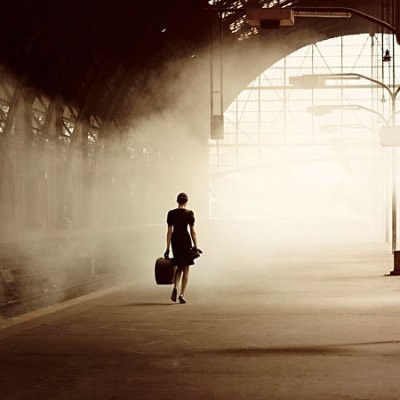
I am about to go on holiday for seven weeks. I have never had a holiday even half that length before. Somehow this feels like leaving.

Yet I will be coming back.

So experiencing some of the emotions of leaving when I’m not, leaving… is new to me.

How long does the leaving have to be before it feels like leaving?


growing down

image

Mostly we go through life growing up.

We get older. We learn from experience. We generally therefore get wiser. We get more aware, more tolerant, more reasoned.  We have knowledge, wisdom and experience on our side. So we can make better decisions, better choices. We can be balanced, measured, sage.

Maybe?

A A Milne’s book “Now we are six” is a wonderful collection of children’s poems that ends with this verse…

When I was one,
I had just begun.
When I was two,
I was nearly new.
When I was three,
I was hardly me.
When I was four,
I was not much more.
When I was five,
I was just alive.
But now I am six,
I’m as clever as clever.
So I think I’ll be six
now and forever

A child’s logic. A child’s wisdom.

The problem is we don’t stay six, now and forever. We become, seven, fifteen, twenty six, fifty one, seventy three. At each stage of ‘growing’ we take on more rigidity, more stuckness, more ‘one way’ thinking. Life experience actually binds us. We learn rules, habits, behaviours, beliefs which constrain our potential.

Take a challenge you face today. Maybe it’s about money, time, work, relationships?

How would a six year old face this? What creative, unbounded, imaginative solutions come from the naive, inexperienced, free mind of a child?

Anything is possible. Maybe adults should start growing down? Going back to the free, unencumbered wisdom of childhood.

Maybe we all need to stay six forever?


not what, but how

how

When you choose the behaviour, you choose the consequences

All too often we focus on the end game. The result. The success. The failure. The implications. The achievement. The gain. The outcome. The goal. The consequences.

How we get there though, colours the outcome. It is the ‘how’ that people notice and the ‘how’ that people remember. It is the ‘how’ that affirms alignment to our values.

bringing order to chaos

chaos to order

Someone I spoke to today, said they see their role as bringing order to chaos.  Now I don’t wish to dismiss this skill. I could probably do with an injection of this ability myself at times, but I do wonder …

… what’s wrong with chaos?

When did we decide chaos was a bad thing, something to be controlled, managed, ordered?

Chaos theory expounds that complex systems, whose behaviour is highly sensitive to slight change in conditions, can generate strikingly great consequences from very small alterations.

That could be a good thing, couldn’t it?  Given we are all uniquely complex, given all our human interactions are complex, given our world is complex, maybe we are denying ourselves unimaginable possibilities, inconceivable freedoms, great achievements by setting out to order the chaos?

Maybe instead we should allow more chaos in the order?  Let it be?

the graduates of today…

image

I’ve spent some time today with some new graduates joining the organisation.  It’s day two for them.

Driving to the venue I reflected on being one of them…  thirty years ago.

I was now standing in front of them, much as key leaders had been marched out in front of me all that time ago. Then, the leaders were booted and suited. Ties, business suits and highly polished brogues. Today I am in an open neck checked shirt and chinos. Over or under dressed?

I sat on a panel as groups presented their thinking around a business priority. We questioned them, then they questioned us. They seem more worldy wise than I recall being in my time. Great questions about society, change and cultural diversity. A colleague on the panel suggested our pension was in safe hands.

My session with them explored self, authenticity and learning agility. And it seems that although the graduates of today are more connected, more aware, more socially responsible and possibly smarter, they still suffer everyday human frailties. They were still worried about how they came across, still wanting to be reassured, encouraged. They still wanted to be heard, accepted, understood. They discussed self awareness and being themselves, yet they still had limiting beliefs about what was possible, albeit fuelled by a hunger to achieve and succeed.

It seems that whilst much has changed in thirty years, much is the same.

Their very humanity, their vulnerability, their humanness, no different to ours all that time ago.

Maybe that’s a sign of how we need to develop our education, our learning about being human? Maybe the focus on learning ‘stuff’ is strangling our ability to learn about the nature of being human?

moving to a new age

image

The world is changing.

We hear that a lot lately. Technology, society, East catching West, globalisation, consumerism, social media, virtual reality, robotics etc. Much is indeed changing.

But are we changing with it, or are we trapped, caught in our own story?  A story spun by the very creators and enablers of the change. Much of what we refer to as change is simply the inevitable out turn of the industrialisation age. These early industrialists promised us: work hard, fit into the schemes of work we define, do what’s asked and you will be looked after, you will get what you want. Factories, mass production, even the idea of management, all born at this time.

Now, we’re caught, in this late-capitalist phase of our society. Our narratives about work remain oriented to this thinking. Work days and weekends. Home and the workplace. Career. Professions. Trades. Status. Money. Recognition. Security. Control. Management. Competition.

We learn, more or less successfully, how to mould ourselves to the categories already on offer in the world – factory worker, administrator, school teacher, manager, accountant, doctor…

For the most part we cope. Some thrive. Many however become disenchanted. Disenfranchised. The system isn’t working for them. The rewards may come, but they’re not enough, or they don’t bring happiness. The ‘have nots’ judge the ‘haves’ – the rewards aren’t fair, equal. Our hearts and souls are stunted by the repeated self-abandonment that fitting in can require of us. Square pegs, round holes. Freedom lost to a defined, managed, measured way to do, to be.

And now, a looming challenge is that many of those roles themselves have gone, are going, or will go in the next twenty years. Falling victim to the very possibilities the Industrial Age and its offspring the Technological Age, have created.

Time for a new way of thinking? A new paradigm?

One with enhanced caring and social responsibility perhaps? One that champions a calling maybe? One that redefines contribution and reward? One that places humanity ahead of hierarchy? Who knows? One thing seems clear though, we need to start to define and move to a new age.


life will be violent, all will be lost

We have developed speed but we have shut ourselves in. Machinery that gives abundance has left us in want. Our knowledge has made us cynical, our cleverness hard and unkind. We think too much and feel too little. More than machinery we need humanity; more than cleverness we need kindness and gentleness. Without these qualities, life will be violent and all will be lost.

Charles Chaplin
(speech from the Jewish barber in The Great Dictator)