the nature of connecting

image

I was trying to explain to a colleague the other day how I see patterns and connections in things.

“For me, everything is connected to everything else…” I said.

Of course, on reflection that’s probably not true. Kumquats are unlikely to be connected to my retirement. The price of aluminium not really connected to the music on my favourite playlist.

What is true though, is that I do see patterns and connections in things which aren’t obvious to other people. They are however obvious to me. That’s not a statement suggesting that others are missing something, or somehow not as able, or that I’m ‘right’. It just is. I can’t always explain the connection, or why it is significant to acknowledge the connection, but they are often both real and meaningful, to me at least.

What is also true, is that I find it hard to do a mind map – for me, things need to be on more than one ‘branch’, some branches need to be joined up. It isn’t therefore a means to clarifying data, as it is for some, rather a way to create complication and frustration.

I have in the past noticed different people connect things in a variety of ways. I recall running numerous workshops over the years, where delegates, asked to group or theme brainstormed post-it notes, would often group them together if they had, for example, the word ‘training’ on them. To me, this ‘connecting’, whilst valid, missed out on the meaning beneath the words.

It seems we all make connections, make meaning, in different ways.  Maybe you make connections in one of these ways?

These things are about the same subject, so they must be connected?
These things are related through cause and effect?
These things are all connected to a specific outcome?
These things form part of the narrative, the story?
These things have a similar significance?
These things together open up possibilities?

Where we find meaning and connection, because we all do it differently, sometimes leads to misunderstanding, disagreement, confusion. So worth exploring the methods you consciously and unconsciously apply?


meta to the meta

image

Meta tags appear on web pages. They aren’t visible to the reader, they contain data describing the page. Data on the data, if you will. ‘Meta’ can also be described as a concept which is itself an abstraction from another concept.

Going ‘meta’ to a situation can also be a self referential place; stepping outside of oneself to observe oneself.

An example might be to ask “What do I think about my thinking?” Or perhaps to explore, “How do you reflect on those reflections about that?”

Sometimes, creating a different physical perspective can help still further. Try this out…

Sit and think about a problem or issue you are currently grappling with. Notice what you’re thinking and feeling as you explore this difficulty.

Now, get up and stand across the room, looking at the original chair or place you were just in. Here you are no longer thinking about the original problem, instead you are considering the thinking about the problem.

Ask yourself “What do I notice about that thinking?”  Ask yourself “What do I think and feel about that thinking and what do I hear in that thinking?”

Notice what comes to mind. Perhaps you think the thinking was a little negative or judgemental? Maybe you notice uncertainty or confusion? Maybe you notice more than one perspective in the thinking – like an internal dialogue? Notice whatever comes to mind?

Now, stand in a third place; another part of the room, still further from the original chair. This time look at the place where you were standing a few moments ago; the second, reflective place. From this new third place, ask yourself “what do I notice, what do I think, how do I feel about that thinking in that place?” The thinking about the thinking, if you will.

Here you may find new insights. New meaning. New significance. New awareness on the original issue… as you go meta to the meta.


bubbly evolution?

image

There’s a new phenomenon in our world.

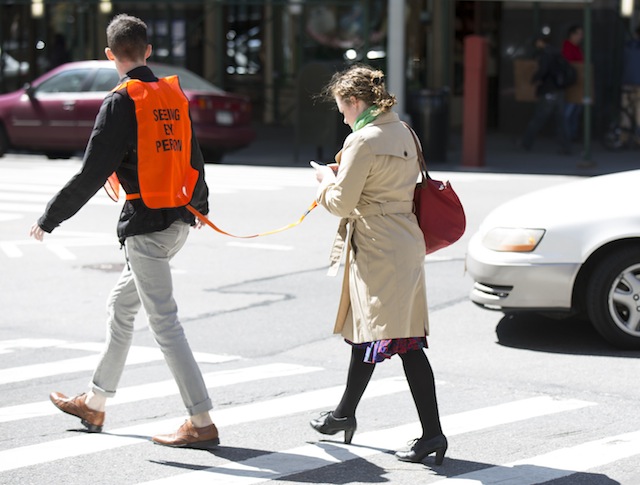
The smartphone bubble. It’s a personal space where we get lost. Lost in our own system of connection.

Walking along the streets you can see these people lost in their private bubble.

There are several subtly different forms. The ‘blind communicator’. Here the smartphone ‘bubblist’ meanders in their texting posture, head bent, eyes down, thumbs dancing over the screen. They are oblivious to anyone around them. To the human being walkers dodging them on the pavement, the human being drivers avoiding them as they step into the road in their zombie like torpor – they are communicating through text, and the person 200 miles away matters more than you, stepping aside for their benefit right here, right now.

Then there is the ‘desperate not to miss outer’. These individuals are addicted to their social media stream of ‘news’. These are often one handed bubblists. They use their dominant thumb in an upward or downward stroking motion, browsing their newsfeed; a constantly rolling list of images, messages, videos and news items that, until that moment, they were completely unaware of. But now, this stream of news prevents them from glancing upwards at the real human beings dodging these ‘mustn’t miss out bubblists’ meandering along the streets, through the shops and bumping and bouncing their way through busy thoroughfares.

Then there is the ‘you all need to knowster’. This form of bubblist often has their eyes open and can see the human beings coming. However they insist on sharing their telephone conversation with everyone on the bus, the train, in the restaurant or simply passing in the street. They are hands free. Their conversation deserves to be shared with us all. That’s how important they are. How ‘need to know’the topic is. Meanwhile non-bubblist human beings have to accept that their thinking, reading, private moments are to be disturbed by the ‘need to knowster’s need to share.

Whatever happened to simple respect for another human being?

Come on bubblists, look up, smile, speak, step aside. Open a door for, say hello to… a fellow human being. You once were one.


buildings wear hats now

image

There are many new buildings being erected nearby.  It’s interesting to see the construction and in particular one common feature I have noticed. They all have an ‘add on’ on the roof, to house, I presume, the heating and ventilation equipment.

I guess many years ago, such ‘hats’ on our buildings weren’t required?

It’s possible to see the pipe work and cabling in the guts of the building, criss crossing the currently naked ceilings. An infrastructure to support the future comforts, efficiency and effectiveness of the eventual inhabitants. Of course once they take up their positions, this wiring and plumbing will remain invisible and only the fruits of its work will be in evidence to the people interacting and achieving inside this house of work.

Many of the things which enable us to work as individual human beings are equally set up thus.

Much, created as we were being built. Now invisible. Sometimes keeping us comfortable and enabling us to be at our best. Sometimes having the reverse effect, limiting us and making us in some way uncomfortable.

We don’t have the luxury of simply removing the ceiling tiles and being able to maintain or improve this infrastructure. Well, not easily. In truth much remains hidden to us.

Maybe time to check under your hat?


how do you introduce yourself?

i-am

If you’re asked to introduce yourself, how do you begin?

Maybe with your name?  “Hello I’m Steve.”

Our name is the most natural representation of our identity. Since our earliest years it has defined us. Differentiated us from siblings, classmates, friends.

But how do you proceed then? After your name?

Maybe with your job role, or where you come from, or some details about your partner or family? What follows your name is probably context sensitive, but in many situations, when encouraged to say a little more, we might provide all of these details.

But does this describe who you are?

We seem more comfortable to offer up what we do, our employment, career, profession, job title, hobbies. We offer up where we come from, who else is in our lives, maybe our age… in other words our context.

Why do we find it more difficult to describe who we are as a human being?

I wonder if it is in part because that is more personal, more exposing, riskier? Maybe we are embarrassed to reveal our innermost selves? Possibly. But I wonder if it is more because many of us have been given little opportunity to explore and understand who we are?

What drives and motivates you? What do you value highly? What words, actions, behaviours give you a good feeling, and which have the opposite effect? What gifts do you possess? What do you believe to be true about the world, about your place in it – those unwritten rules that determine how you are judged, valued, belong? What excites you in life? What will your legacy to the world be?

Maybe it’s time to start understanding yourself?
Then you can introduce yourself.
Then people can truly meet you.
And you them.

why why?

Germany's Irina Mikitenko runs on her way to winning the women's London Marathon in London

The question ‘Why?’ is one we are familiar with.

We use it to seek understanding, context, reasons.

But an alternative viewpoint might be that it is the most unhelpful question.

‘Why?’ encourages us to repeat the story we have always told ourselves and told others. To tell ourselves, and others, the same untruth. To give ourselves and others permission, justification. That justification in effect a cloak. A cloak to deeper understanding, to enquiry, to learning, to change.

‘Why?’ becomes an (unintended) excuse.  ‘Why?’ effectively keeps us running on the same track; because we tell ourselves why we always have, why we are now, and why we always need to.

So maybe stop providing yourself and others with the excuse.  Ask instead ‘what?’, ‘when?’, ‘how?’, ‘where?’.  These questions explore specifics, they explore truth, they facilitate growth and movement.  They illuminate choice and perspective, instead of justification to remain stuck.

how do you know about pass the parcel?

image

I wonder sometimes if life is like a game of pass the parcel?

The music starts. Life runs.

The parcel moves around the circle.

In the party game, the parcel moves from child to child. In life though, maybe we are handing off one life moment to the next life moment? Passing our life to ourselves, experience by experience? That same self sitting next to us in the circle, about to live our next life episode?

In the game, the music stops. The anticipation of a gift, palpable. The joy of revealing it, effervescent. The pleasure of tasting the ‘sweetie’ within, satisfying. Feeling like you’ve won. Our child eagerly tears off the wrapper. Desperate to discover what lies within.

In the game of life, as an adult, we are however too keen to move on to the next scene, the next task, the next phase. We essentially restart the music immediately. No time to reflect on our personal learning. No time to even notice if we had any learning. No curiosity about the ‘sweetie’; that insight into ourselves. Move on. Pass the parcel of life to your adjacent, same self.

If we viewed life as a game of pass the parcel, where we stopped the music and enjoyed the self learning, the insight into how we’re growing as a human being, who we are, who we are becoming, where we’re going; how much richer would we be?

What if you don’t know about pass the parcel? What if you have never explored yourself, how you tick, how you come to the world, how you are evolving, your gifts, why you are here…? What if you just pass the parcel of life on to your same self neighbour? What if the music keeps playing?

Start now.
Play the game.
Tear open the gifts.
Learn to learn.
Learn to grow.

The game never ends.
The learning never stops.
Until the music does.

does Father Christmas exist?

belief future Christmas
When I was a child I believed in Father Christmas.

In part because my parents told the tale and I believed in them. I trusted them as parents. As adults.

In part also because it served me well. I was rewarded. Brightly wrapped presents, sweets and other childhood delights were bestowed upon my compliance. My letter to Santa, brought me gifts.

In part also because everyone else in my child world believed too. I was fitting in by believing, rather than being outside the group.

*Spoiler alert* I don’t believe in Father Christmas now; although I perpetuated the myth with my own children when they were small.

Our beliefs about the world change over time. So too our beliefs about ourselves.

What I believed about work when I was 12 was quite different to what I believed twenty years later at 32. What I believed about the value of money has shifted again in the last twenty years. Certainly my beliefs about girls were very different at 12 to those I held at 22. My beliefs at 40 about human beings, compassion, possibilities are quite different to those my sixteen year old self held. My beliefs about what is important have shifted too. So too my beliefs about my abilities. And much more.

The point here is that our beliefs change over time.

I wonder how would it be if we set an intent to shift a belief in advance? Rather than it shifting simply through the ageing process and maturity, as a result of situation, life experience, context. What if we decided now, what we wanted to believe in say a decade?

What do I want to believe in ten years about money, about fun, about time, about learning, about being healthy, about happiness, about relaxing, about pleasure, about society, about religions, about conflict, about equality, about difference, about humanity?

Can I in some way change my future if I set out, now, to have a different belief about these things in my own future?

Maybe different gifts are possible? Not those delivered by Father Christmas, but by increasing my awareness of myself and by setting out to believe different things about me and the world I live in… what might be?

Now that, might be worth wrapping with a bow.