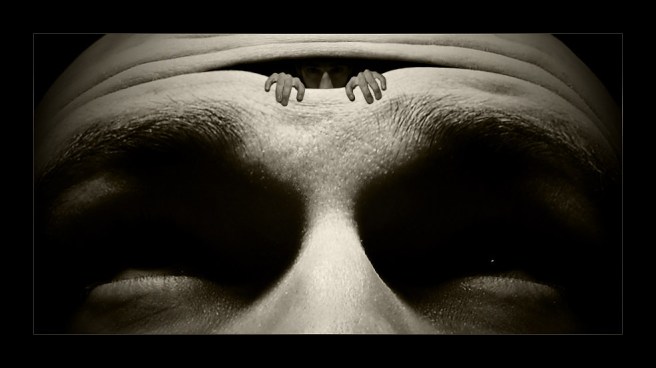
mindless thinking?

image

The mind’s job is to validate what it already thinks

Byron Katie

Sometimes we fool ourselves into thinking we are thinking. That we are using our higher cognitive capabilities to make choices, rationalise, decide. To use our intellect.

Our minds are perhaps the best pattern forming device we know. So once a pattern is there, we usually lose the ability to think around it. Instead our brain tells us what it believes it already knows. It post rationalises so as to prove its pattern is correct.

Something to think about?

journeys

image

I’ve been travelling today.

A road journey, along motorways.

Travelling with companions, both in my car and those in other vehicles travelling a similar route. Some joining, some leaving. Some we passed, some passed us. Some moving slower, some racing ahead.

Some we met again and again. That dance you sometimes enjoy between you and another car. Both travelling at a similar speed, but occasionally because of circumstances, they pull out and overtake you. Then, a mile further on, you return the favour. As if two dance partners holding hands, connected in an invisible link, one pulling or pushing the other into a new move, or a different pose.

We pulled off our route for refreshments. As did other travellers. Recharging for the next leg of our journey.

We never know where our fellow drivers are headed. For this leg, clearly we are travelling together. At a future point they may branch off and head in a different direction, as indeed might we. But for now, we travel together.

It’s a bit like life really. All on a journey.

the isolation of difference

image

The world, it seems, falls into two camps. The majority and the minority.

We even use the words in every day language. Ethnic minority. Minority groups. The silent majority.

If you are in the majority, you get to call the shots. You get to determine right and wrong, to label the minority, to make decisions on behalf of all.

If you are in the minority, you get to feel different, labelled publicly, isolated and badged as ‘the minority’.

I have recently been exploring what are termed neuro diverse conditions – dyslexia, dyspraxia, Aspergers and the like. Neuro diversity is a term coined by those not in these groups. Those same people refer to themselves as neuro typical. Typical meaning simply the majority in this case.

This same phenomenon exists whether your ‘diversity’ is sexual, physical, ethic, religious. If you are in the minority, you can feel labelled and judged by the majority.

One result of this majority minority tension is that many of us seek to be in the majority, to conform, for acceptance. Here is the power. The power of majority. Or we hide, for fear of judgement and rejection. Here is the isolation. The isolation of minority.

Yet every one of us, by some definition, will be in both a majority or a minority. So let’s stop all this nonsense.


looking back

image

If you were to replay your last 24 hours in reverse, what might you change?

Would you add something in? Something you meant to do, or with the benefit of the ‘end of day’ hindsight, something you would have slotted in?

Would you take something out? Something that didn’t add value or which, with the benefit of knowing the whole, the end point, you might just simply not do?

Would you change the sequence? Swap two pieces around?

Would you start something earlier or later? Or maybe finish something sooner?

Would you change durations? Do more of something or less of something?

Do you have any regrets?

If we start from the end of our day, looking back, how might our choices be different? Tomorrow, imagine you are starting at the end. What choices might you make, before you begin?

Then, at the end of tomorrow, review your day. Anything different?

Sketch by: Joe Nammour


let’s draw a line

image

It seems we like lines.

In organisations we draw them everywhere. This business, that division, this function, that department, this team, that group, my role, your role, this project, that programme.

Each time we draw a line it seems to both instill a sense of identity and belonging, whilst at the same time creating a barrier, an ‘us and them’.

The line tells me my place, I’m somehow safe, bounded by this imaginary line. I belong here. The interface between the parts, across the lines, generating a need to manage that boundary. We create roles to bridge the relationships, measures to show the performance of the parts, brands to show the difference… reasons to apportion and explain the blame.

But we like lines.

If the lines are removed, we seem uncertain about how to behave. Who is responsible? Who is accountable? Where are the hand-offs? Who am I? Who are you? How does it all fit together?

It’s like we become a jigsaw where the pieces haven’t been cut out, so we can’t see how they interconnect.

Lines, it seems, are everywhere though. Not just in large organisations.

I was speaking with someone the other day about their business. They work alone, as an associate delivering great creative stuff. They are pitching for a bit of work under their own brand and, in our conversation, seemed somehow uncertain – because of a line they had created for themselves. My business. Someone else’s business.

We create lines in families too. Blue household jobs and pink household jobs. His room, her room. My car, your car. My brother’s role, my sister’s role.

Lines.

Useful or a constraint?

the passing of life

image

When we hear the sad news of a celebrity or significant public personality passing, it reminds us of our own past.  Often our connection is to a shared time – the music we listened to, the films we saw, the events we witnessed.

It is the memories of those days, those shared times, the recollection of our own dim distant youth and the good times therein, that often brings the sadness, the emotion, maybe the tears.

When people close to us pass away, the number of connections is more, the richness of the memories even brighter, deeper, warmer.

It is at these points of passing, that we reflect on our own mortality. When lives end, we pay attention to the passing of our own years. Time slipping away.

Yet life is passing with every moment.

Each passing hour, minute, second is a moment of our own lives; and so many we let go without conscious thought.

So many pass without reflection to their significance; so many pass in the blink of an eye; so many slip away without time to relish their part in the contribution to our own evolution, our own personal learning and growth.

So many pass without awareness to the contribution we make to the richness of others memories. The people we touch. The difference we make. The memory making moments our existence has had, to those around us who will be here long afterwards.

The passing of life isn’t about death, it’s about now. This minute, this moment.


RIP David


like antimatter…

image

When do you pause?

I suspect you pause all the time. Mostly just for a second. To draw breath. To find your words. Distracted. Maybe you pause between listening and speaking? Maybe between speaking and listening? Maybe you pause to reflect? Maybe you pause before beginning? Maybe when your attention moves? Maybe you never pause? Maybe you just never notice your pause?

I wonder if in fact it’s all about the pause?

Maybe the pause is the important part? Everything else is just there to fill the gaps between the pauses.

Like antimatter perhaps?

What if we were to notice, honour, embrace the unseen pause?